
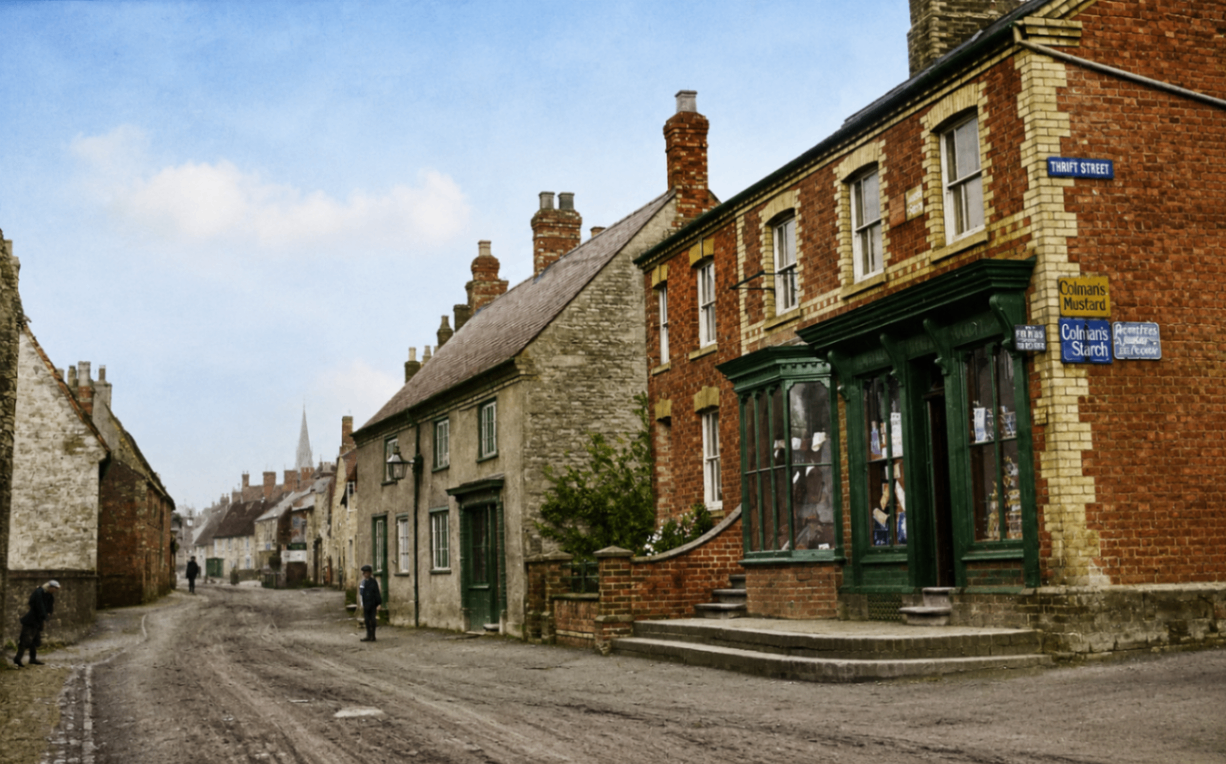
Village History
Old Shops of Wollaston
Remembering the Co-op, bakeries, sweet shops, butchers, laundries, showrooms and village businesses that once shaped everyday life.
Wollaston once had far more shops and small businesses than it does today. Before supermarkets, online shopping and widespread car ownership, villagers relied on local shops for bread, meat, groceries, sweets, repairs, banking, laundry, shoes, hardware, newspapers and everyday services. Many of those former shops are now private homes, apartments or different businesses, but the buildings still hold memories.
Historic records suggest that at its peak in 1924 Wollaston had 29 separate shops, a number of which belonged to the Co-operative Society. Many village shops were in buildings dating from the late Victorian and early twentieth-century period. The Co-op was especially important in Wollaston, with grocery, bakery, butchery and other services remembered by residents.
Wollaston also has a wider co-operative history linked to the boot and shoe trade. Northamptonshire Productive Society was established in 1881 by Wollaston shoemakers in a dove house in Thrift Street. This helps explain why the Co-op and the idea of thrift and mutual support were such important parts of village life.
Background
Why Wollaston had so many shops
In earlier generations, village shopping was much more local. People walked to buy bread, meat, groceries, sweets, newspapers and household goods. Many shops were family-run, and some buildings changed use many times over the years. Wollaston's High Street, Newton Road, London Road, Thrift Street, Howard Road and the lanes nearby all had places that residents still remember as part of daily life.
Old shops were not always purpose-built. Some operated from front rooms, corner buildings, converted houses or yard buildings. Some shopfront clues may still remain today — wider windows, corner doors, old signage positions or altered brickwork are all signs that a building once served the public.
Major feature
The Co-op Years: grocery, butcher, bakery and village life
The Co-op was a major part of Wollaston's shopping history. Residents remember the Co-op as more than one shop: there were grocery, bakery and butcher's connections, with different buildings around High Street and Newton Road associated with Co-op activity over time. The Co-op was part of the everyday rhythm of village life, and its influence is still remembered in connection with Thrift Street and Wollaston's wider co-operative traditions.
Kelly's Directory, 1910 — confirmed record
Co-operative Industrial Provident Society Limited
Kelly's Directory of Northamptonshire (1910) formally records the Co-operative Industrial Provident Society Limited as a named commercial entity in Wollaston. This confirms that by 1910 the Co-op was not merely a local memory but a formally constituted society — part of the national co-operative movement that served working families across industrial England.
In a village built on the boot and shoe trade, the Co-op's role was especially significant. Working families needed reliable, affordable access to food, fuel and household goods — and the Co-op's dividend system meant that regular shoppers built up a small return on their purchases. Wollaston's co-operative tradition runs deep: the Northamptonshire Productive Society (NPS), founded in 1881 by Wollaston shoemakers, is the UK's oldest surviving workers' co-operative.
The old Co-op and the later library
Local memories suggest that the building at the end of the High Street later became the library after the Co-op had a new grocery store built on Newton Road. The newer Co-op grocery building is now remembered as the library on Newton Road.
The Co-op butcher's
The Co-op butcher's is remembered as being next to the newer Co-op grocery store on Newton Road. That building is now remembered as the Chinese takeaway.
Bakery and sweet shop memories
The Co-op Central Stores at 5 High Street (corner of Thrift Street) housed multiple departments including the sweets and cake shop kept by Elsie Murdin, the drapery, and the hardware store. That building is now Ele's Bakes.
Thrift Street and co-operative Wollaston
The Co-op was big in Wollaston, and local memory links this wider co-operative culture with Thrift Street. Wollaston's co-operative tradition also connects with the boot and shoe trade and the Northamptonshire Productive Society.
Research archive
Street by street: shops and traders
The following directory has been compiled from the 1939 Register, Kelly's Directory (1901 and 1924), Ivy Walker's memoir held by the Wollaston Heritage Society, and Facebook group memories. Sources are noted against each entry. Entries marked with a flag have open questions that the community can help resolve.
High Street
The main commercial spine of the village. Several buildings still show signs of former shopfronts — wider windows, corner doors, altered brickwork.
114 High Street
Veterinary SurgeonEdwin Boyson, veterinary surgeon, born 1875. Recorded at this address in the 1939 Register. Earlier directories list him as a farrier — the same man across a career that moved from farriery into veterinary practice.
Post Office, 100 High Street
Post Office / sub-postmasterFrank Reynolds, sub-postmaster — confirmed in the 1939 Register, Kelly's 1901 and Kelly's 1924.
98 High Street
NewsagentThomas Bason, newsagent, born 1899. Recorded at this address in the 1939 Register — next door to the Post Office at 100 High Street.
92 High Street
TailoressBarbara P. Armstrong (née Moore), tailoress, recorded at this address in the 1939 Register.
84 High Street
HairdresserHarold Brown, hairdresser, born 1920. Recorded at this address in the 1939 Register.
Co-op Central Stores, 5 High Street (corner of Thrift Street)
Co-op — drapery, sweets, hardwareThe Co-operative Industrial & Provident Society Ltd occupied the corner building at 5 High Street, at the junction with Thrift Street — now Ele's Bakes. A photograph of the shopfront survives showing the full fascia reading "Industrial & Provident Society Ltd." with a bay window to the left and display windows full of drapery and haberdashery. The building housed multiple Co-op departments over the years: the sweets and cake shop (kept by Elsie Murdin), the drapery, and the hardware store (managed by Margaret Darnell, later Woodhams — selling paraffin, furniture, pots and pans, bedding and lino). Kelly's 1910 records the Co-operative Industrial Provident Society Ltd as a named commercial entity in Wollaston.
Co-op Grocery & Provisions — High Street (exact building unconfirmed)
Co-op / groceryA period photograph survives of a Wollaston Co-operative Society Grocery & Provisions shopfront — Kellogg's, Fry's Chocolate, Lyons Tea, Bovril and Sunlight Soap visible in the windows. Believed to be on the High Street but the exact building has not yet been confirmed. Do you recognise it?
Arthur Talbutt's, 37 High Street
Newsagent / general storeArthur Talbutt, newsagent and general store. Confirmed at 37 High Street — the shop he built opposite his mother's (Granny Talbot's shop). The 1939 Register places him at 37 High Street; community memory places the shop opposite number 40 High Street, consistent with this address.
20 High Street
General grocerSelina Brown, general grocer, born 1883. Recorded at this address in the 1939 Register.
Granny Talbot's shop
High-class grocery / confectioneryRemembered as "high class" — first tomatoes of the season, boxed chocolates for special occasions. Matches Florence Talbot (Mrs.), shopkeeper, in Kelly's 1924.
13 High Street
HardwareCecil Sherwood, hardware sales. Likely the next generation after George Sherwood (cycles/repairs) on St Michael's Lane.
Williams the Butcher
ButcherCorner of St Michael's Lane and High Street.
Leonard M. Carrington
HairdresserHigh Street.
Albert W. Green
PrinterHigh Street.
Photo opportunity: Look for altered shopfronts around numbers 37–100 — wider windows or corner doors that hint at former retail use.
Do you remember any other High Street shops not listed here? Do you have photographs of the shopfronts?
Thrift Street
Heart of Wollaston's co-operative story. The Wollaston Industrial and Provident Society was founded in 1876 — its bakery, butcher's and Working Men's premises were here on Thrift Street. The Northamptonshire Productive Society (NPS), a separate shoemakers' co-operative, was also founded in the village in 1881.
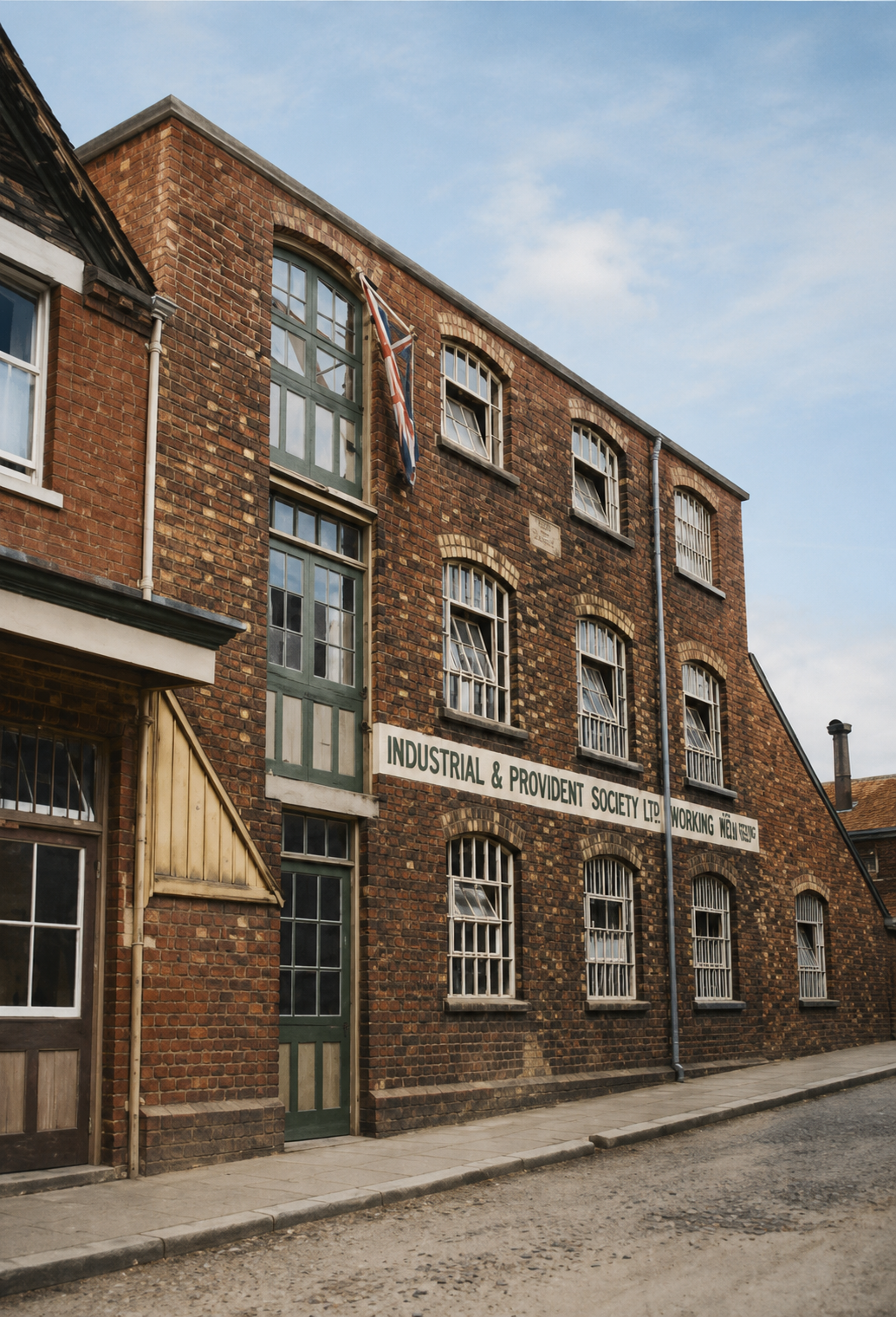
The Co-operative Industrial & Provident Society Ltd. Working Men's premises on Thrift Street — a substantial brick building with arched windows, Union Jack flying, and the full society name across the fascia
Isaac Murdin
ChinaMiddle of Thrift Street.
Mrs Darnell's shop
General goods / quasi-chemistSold cod-liver oil, liniment, gripe water, Snowfire, plus groceries and haberdashery. Matches Darnell, Elizabeth (Mrs.), shopkeeper, in Kelly's 1924.
Co-op bakery and Working Men's premises
Co-op / bakeryA photograph survives showing the full "Industrial & Provident Society Ltd. Working Men's" fascia across a substantial three-storey brick building with arched windows and a Union Jack flying. The premises housed the coal yard and bakery, with a butcher's and abattoir behind.
Co-op butcher's, Thrift Street
Co-op / butcherA photograph survives showing the Co-op butcher's shopfront with a delivery bicycle bearing the name "Wollaston Co-operative Society". The butcher's had an abattoir to the rear.
Photo opportunity: The bottom of Thrift Street — look for any surviving Co-op or industrial building details.
Do you know exactly which buildings on Thrift Street were used by the Co-op bakery or coal yard?
Wall Terrace / Rotten Row
A cluster of small shops remembered along the terrace, including Co-op branches.
Mrs Kitty Rogers
Secondhand clothes and furnitureBottom of Wall Terrace. Matches Rogers, Kate (Mrs.), greengrocer, in Kelly's 1924.
Leonie Brown's shop
General grocery / sweetsFacing Rotten Row. Loaves baked by Martin Brown.
Photo opportunity: The Wall Terrace and Shelton Court area — look for any surviving shopfront details.
Can you help identify the sweet shop or the family who ran it? Do you know which Co-op branches occupied which buildings on Wall Terrace?
The Square
The open area at the heart of the village. The Cradle — land opposite the Nag's Head where the lime tree stands — was used for tethering stray animals and later as a bus stop.
Mrs Palmer's shop
Sweets / ice creamSweets, and homemade ice cream every summer.
The Cradle
Village landmark / bus stopLand in the middle of the village opposite the Nags Head Hotel, where the lime tree stands. Used historically for tethering roaming cattle and sheep until owners claimed them; later became a bus stop for incoming and outgoing passengers. A well-known village photograph was taken from this spot.
Do you remember Mrs Palmer's shop or the ice cream she made? Do you have photographs of The Square from earlier decades?
London Road (Strixton End)
Now known as London Road, this end of the village was historically called Strixton End and had its own cluster of small traders, including Mrs Ball's fish and chip shop opposite the Nag's Head.
Mrs Ball's shop
Fish and chipsWet fish, mainly fried fish, chips and wafers. Remembered as opposite the Nags Head, dressed in the style of Queen Victoria. Matches Ball, Charlotte (Mrs.), fishmonger, in Kelly's 1924. The site was later occupied by Craxtons & Fowler Carpentry.
Jinnie Summer's sweet shop
Sweet shopHalfway down what was then called Strixton End, now London Road.
Freddie Shelton's smallholding
Flowers and vegetablesNot a shop as such, but a village supplier of flowers and vegetables.
Do you remember Freddie Shelton's smallholding or Jinnie Summer's sweet shop? Do you have photographs of this end of the village?
London Road
London Road carried traffic into the village from Wellingborough and had a varied mix of traders — grocers, a laundry, a dairy, a draper, a cycle agent and eventually garages.
The 1905 Packwood fire is documented separately below.
67 London Road — Houghton's / Brown's / Maynard's
General grocery / sweet shopConfirmed in the 1939 Register: John Houghton (b.1890), Manager, General Shop, and his wife Florence Houghton (b.1892), Assistant, General Shop, recorded at 67 London Road. 1940s: "Tiggy" Houghton, sold whatever he could get his hands on post-war. 1950s: Brown's — sold everything including snuff, loose goods (sugar, salt, flour) weighed from sacks into paper bags; run by "Jack" (surname uncertain, Davis/Davies?), with assistant Nora. Later: Maynard's, small grocery, sold sweets; Mrs Maynard was Brown Owl and ran the St John Ambulance cadets.
Harry Eaton's shop
Greengrocer / gameVegetables in season, snared rabbits, marrows.
Lou Cox's shop
Sweets and groceriesTop of Partridge's Hill.
Lew Rivett's shop
Shop (type unconfirmed)High counter, opposite side of London Road.
Mr Hayes (from Bozeat)
DraperChildren's and ladies' clothes. Matches Hayes, William J., draper, in Kelly's 1924.
Watson's shop
Sweets / lending librarySold sweets and ran a lending library. Later the house occupied by Ernie Bryant.
Cooper's Dairy
Dairy / provisionsHomemade pickles, cheese, horseradish sauce. The site later became the Chemist.
Arthur Pearson's shop
Cycle agent / petrolCycles and repairs, with a single petrol pump — "the forerunner of the garage." Matches Pearson, Arthur, cycle agent, in Kelly's 1924. See also the Garages section.
Pearson's Garage
GarageBuilt after a row of stone houses on or near the site was demolished (one occupied by John Lack's father-in-law's family). See the Garages section for the full story.
86 London Road
BlacksmithEdgar Smith, blacksmith.
55 London Road — Lucy's Laundry
LaundryAnnie Lucy, laundry proprietress (1939 Register). Matches Lucy, Hugh John, laundry, in Kelly's 1924. Ivy Walker's memoir records that Lucy's clientele reportedly included the Spencers of Althorp and the Duke of Buccleuch. The building at 55 London Road is The Gables.
William Packwood's draper's shop
DraperLeft-hand side of London Road coming into Wollaston from Wellingborough. Destroyed by fire on the night of 25 July 1905 — see the Packwood Fire entry below.
Photo opportunity: The junction of High Street and London Road — look for altered shopfronts, wider windows or corner doors.
What was the surname of "Jack" at Brown's on London Road in the 1950s (possibly Davis or Davies)?
St Michael's Lane
A short lane off the High Street with a small cluster of traders.
Mrs Lack's shop
Shop (type unconfirmed)Opposite Williams the Butcher, other side of St Michael's Lane. Possibly related to Frederick Lack, shopkeeper (Kelly's 1924), and the Lack family noted near Pearson's Garage.
George Sherwood's shop, 24 St Michael's Lane
Cycle dealer / repairs / shoe workGeorge E. Sherwood, born 1869, confirmed at 24 St Michael's Lane in the 1939 Register as a cycle dealer. Also matches Sherwood, George Edmund, cycle repairer, in Kelly's 1924. Remembered as "Philip's grandfather." Likely the earlier generation before Cecil Sherwood (hardware) at 13 High Street.
Polly Watts' sweet shop
Sweet shopOpposite George Sherwood's.
Do you know more about the Lack family's shop, or George Sherwood's cycles and repairs?
Council Street
A couple of remembered traders at the top and corner of Council Street, plus a confirmed master baker from the 1939 Register.
18 Council Street
Baker and confectionerReginald Murdin, master baker and confectioner, born 1895. His wife Caroline (born 1895) is recorded as assistant in the shop. Confirmed in the 1939 Register. The Murdin name runs through Wollaston's trading history — Frederick Murdin (baker, Kelly's 1924), Isaac Murdin (china shop, Thrift Street) and Elsie Murdin (Co-op cake shop) are all recorded separately.
Mr York's shop
General storeCorner of Council Street — "a bit of everything."
Teddy Garfirth's
Shoe repairerTop of Council Street.
Do you remember Mr York's shop or Teddy Garfirth's shoe repairs? Do you remember the Murdin bakery at number 18?
Howard Road
Howard Road had a haberdashery and a country supplies shop. A resident's 93-year-old father remembered buying sweets from what is now the hair salon on the corner.
Mrs Simcoe's shop
HaberdasheryFacing up Howard Road.
Buzzer Pratt's shop
Country suppliesHalfway down Howard Road. Sold snares, mole traps, shot for guns.
Photo opportunity: The corner of Howard Road — now a hair salon, formerly remembered as a sweet shop.
Which corner shop was the sweet shop, and do you have memories of the cottages off London Road? Family names remembered here include Summers, Green and Bryan.
Newton Road
Newton Road is remembered for the newer Co-op grocery store (now the library) and the Co-op butcher's next door (now remembered as the Chinese takeaway).
John Brown's bakery, 1 Newton Road
Master bakerJohn Brown, Master Baker, born 1890 — confirmed at 1 Newton Road in the 1939 Register. Remembered in the Ivy Walker memoir as Martin Brown's bakery and shop on the corner of Howard Road and Newton Road; the 1939 Register confirms the Brown family at this address.
New Co-op grocery store
Co-op groceryThe newer Co-op grocery store on Newton Road. Now the library.
Co-op butcher's
ButcherNext to the Co-op grocery store on Newton Road. Now remembered as the Chinese takeaway.
Photo opportunity: The library building on Newton Road and the building next door — formerly the Co-op grocery and butcher's.
Do you have photos of the Co-op grocery store, the butcher's or the early library?
College Street
Mrs Rice's sweet shop
Sweet shopRemembered as the first woman in Wollaston to own a washing machine. Matches Rice, Albert / Rice, William, shopkeepers, in Kelly's 1924.
Pollards Laundry
LaundryDo you remember Mrs Rice's sweet shop or Pollards Laundry?
South Street
Watts' shop
Decorating materialsTop of South Street. Paints, wallpaper, decorating materials. Matches Watts, William J., shopkeeper, in Kelly's 1924.
Do you know more about Watts' decorating shop at the top of South Street?
Hickmire
Mrs Matthews' shop
Shop (type unconfirmed)Matches Matthews, Walter, shopkeeper, in Kelly's 1924.
Lovells
Carpenters / undertakers / wheelwrightsDo you know more about Mrs Matthews' shop or the Lovells carpentry and undertaking business?
Hinwick Road
52 Hinwick Road
PostmanErnest Garforth, postman.
Browns of Hinwick Road
Carpenters / undertakersDo you know more about Browns of Hinwick Road and their carpentry and undertaking work?
Park Street
Haslam's
Shop (type unconfirmed)Opposite the flats. The premises were later converted into a private house in the 1970s.
Do you know more about Haslam's shop on Park Street?
Eastfield Road
A residential road on the eastern side of the village, with at least one confirmed trader recorded in the 1939 Register.
78 Eastfield Road
FishmongerCharles Yeates, master fishmonger, born 1887. Recorded at this address in the 1939 Register.
Do you remember Charles Yeates or any other traders on Eastfield Road?
Not yet tied to a specific street
Kelly's 1924 also records the following traders without confirmed addresses: Robert Charles Smith (grocer); Murdin, I. & Sons and Murdin, Sophia (Mrs.) (shopkeepers); Murdin, Frederick (baker); Luck, Albert; Palmer, Herbert; Perkins, Elizabeth (Mrs.); Watts, William J.; Woods, John (shopkeepers); Barnes, Charles (general dealer); Stone, John (pork butcher); Williams, James (butcher); Drage, Christopher (hairdresser); Speight, William (saddle & harness maker). Public houses — The Nag's Head Hotel, The Boot, and The Cuckoo Inn — are covered on the Old Pubs & Inns page.
London Road — 25 July 1905
A Horrible Fire at Wollaston
On the night of 25 July 1905, a draper's shop on London Road — on the left-hand side coming into Wollaston from Wellingborough — caught fire overnight, killing all three people inside.
The shop was run by William Packwood, aged 51. That evening, after closing the shop, he and the other occupants had attended a travelling cinematograph show in the village. When they returned and retired for the night, fire broke out in the premises.
The three who died were William Packwood himself; his invalid sister Fanny Packwood, aged 68; and their housekeeper Edith Wright, aged 42. Neighbours — the Coopers — raised the alarm. The Wellingborough Fire Brigade was fetched by Daniel Drage, while villagers used a hand-pump from the cinematograph show in an attempt to fight the fire. All three bodies were recovered over the following hours.
The remains were carried to the Nag's Head Inn, where the inquest was later held. The jury returned a verdict of death by fire, cause unknown. The funerals were held on 28 July 1905.
Source: contemporary newspaper account. Not yet cross-checked against the British Newspaper Archive. The exact address on London Road has not been confirmed — if you can identify the building, please get in touch.
Gallery
Then and Now
We are collecting historic and modern photographs of the same locations. If you have an old photograph of any of these places, please share it with us.
Co-op Central Stores, 5 High Street (corner of Thrift Street) — now Ele's Bakes
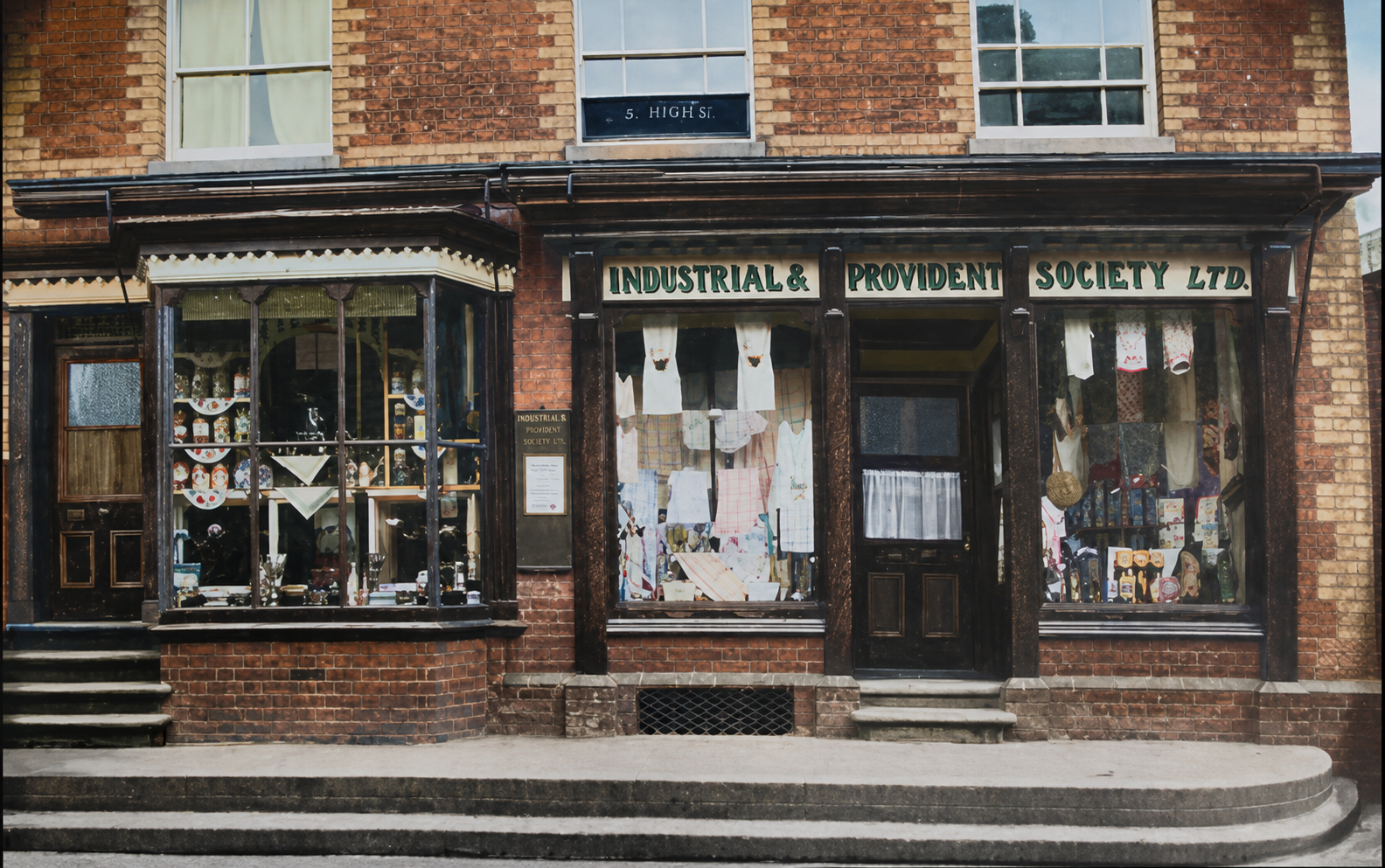 c.1905–1910
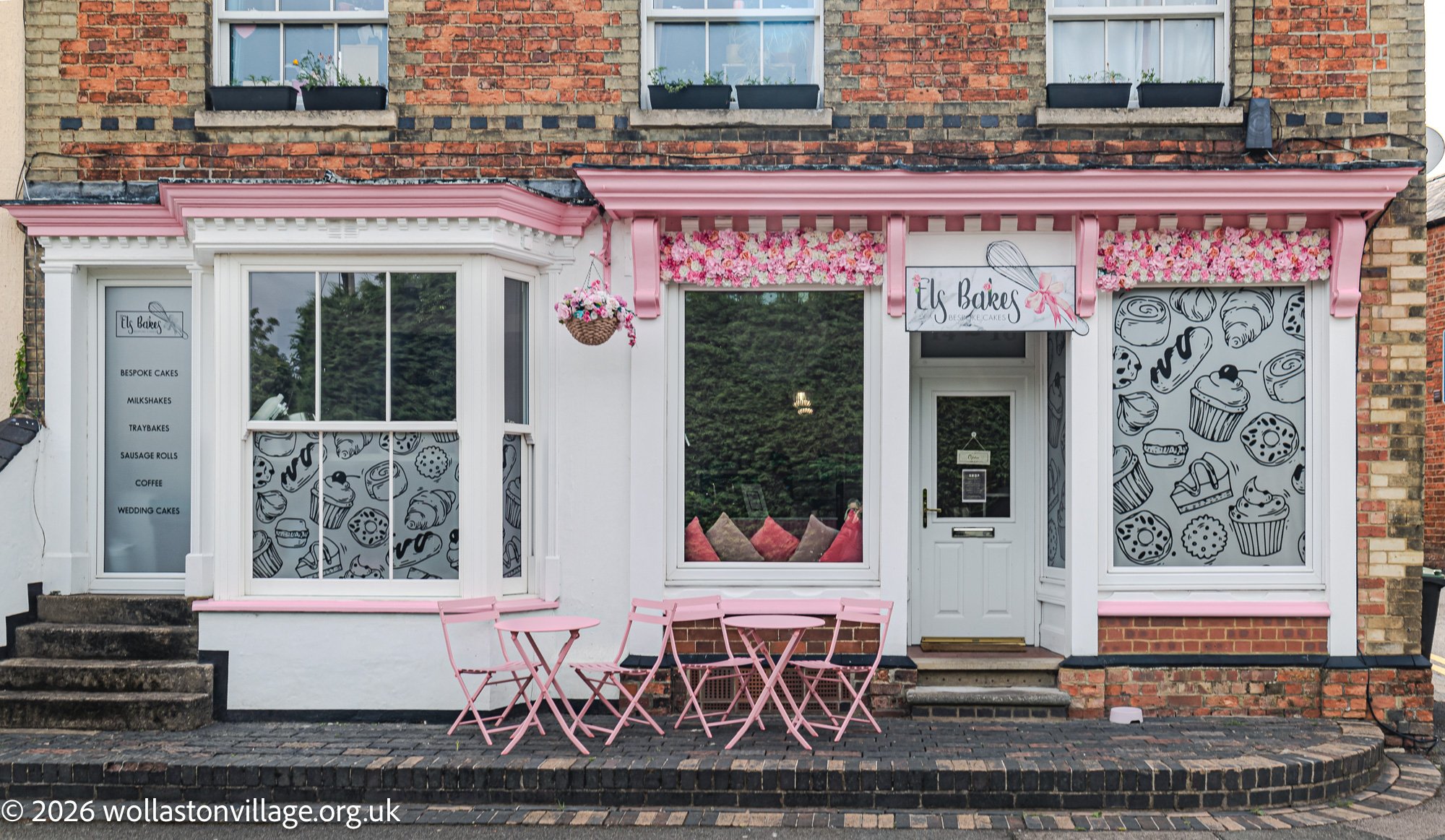 2026
2026Co-op bakery and Working Men's premises, Thrift Street
c.1905–1910Co-op butcher's, Thrift Street — Wollaston Co-operative Society delivery bicycle
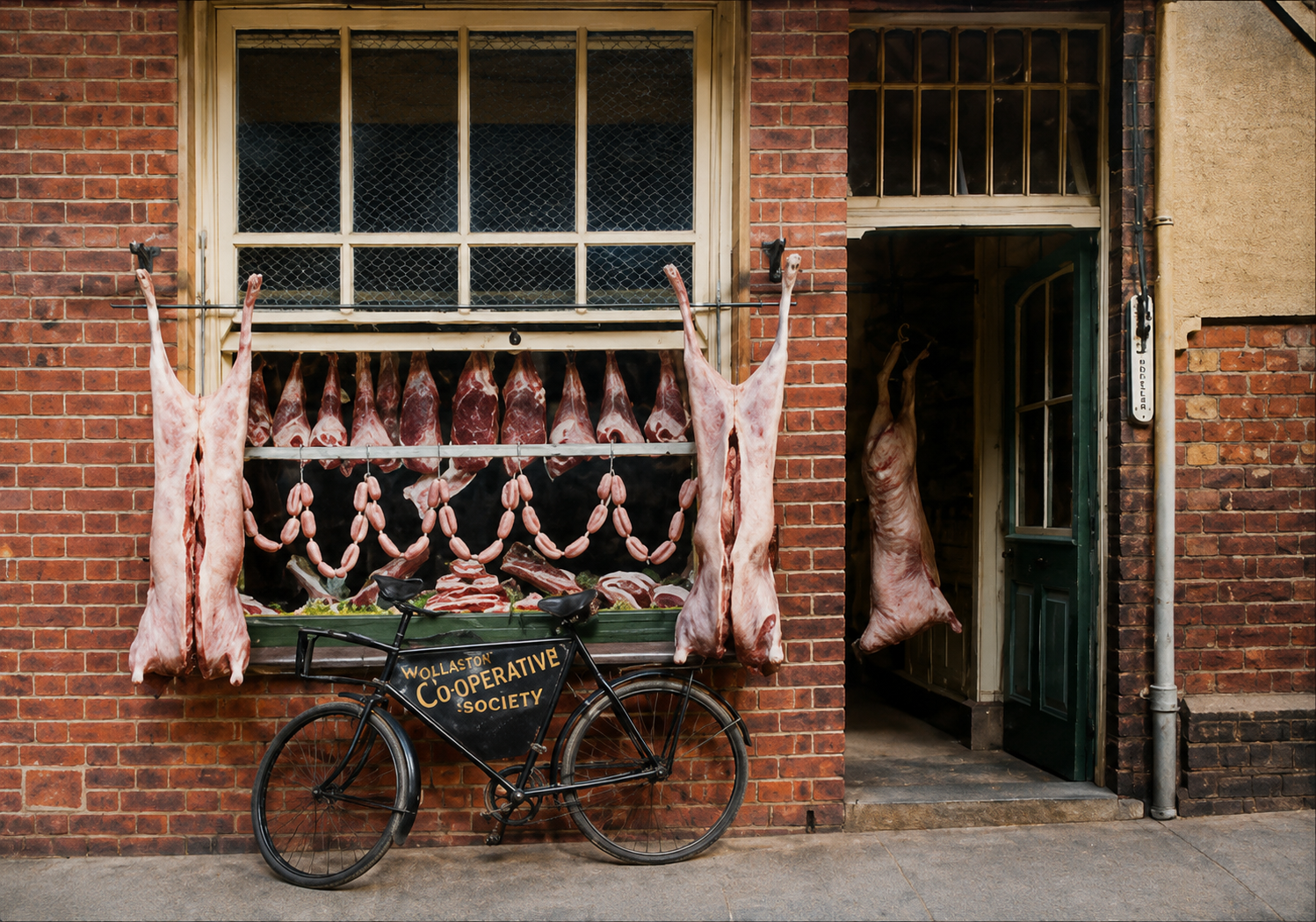 c.1905–1910
Co-op Grocery & Provisions — High Street, exact building unconfirmed
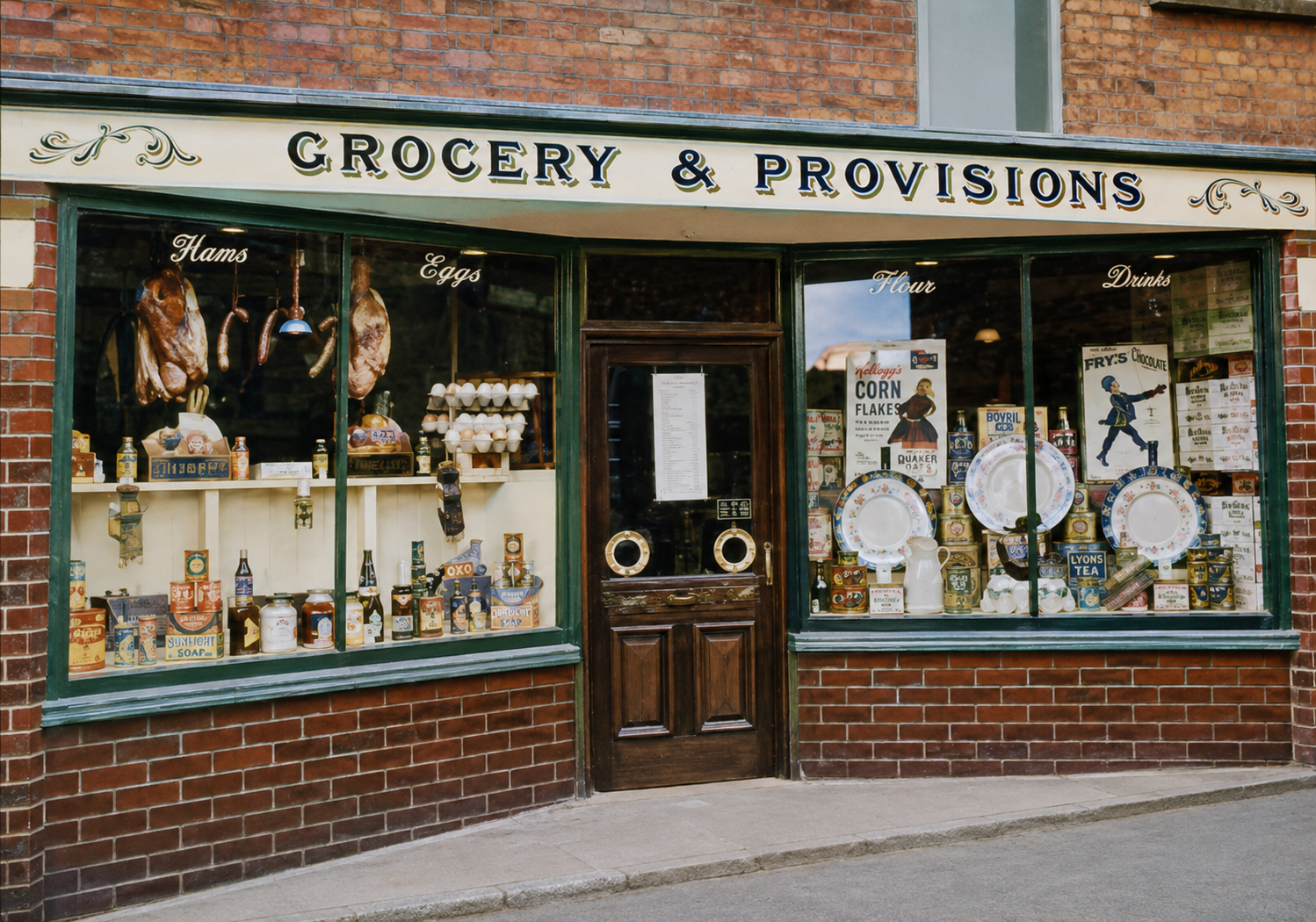 c.1905–1910
High Street — the Co-Op corner store, c.1905
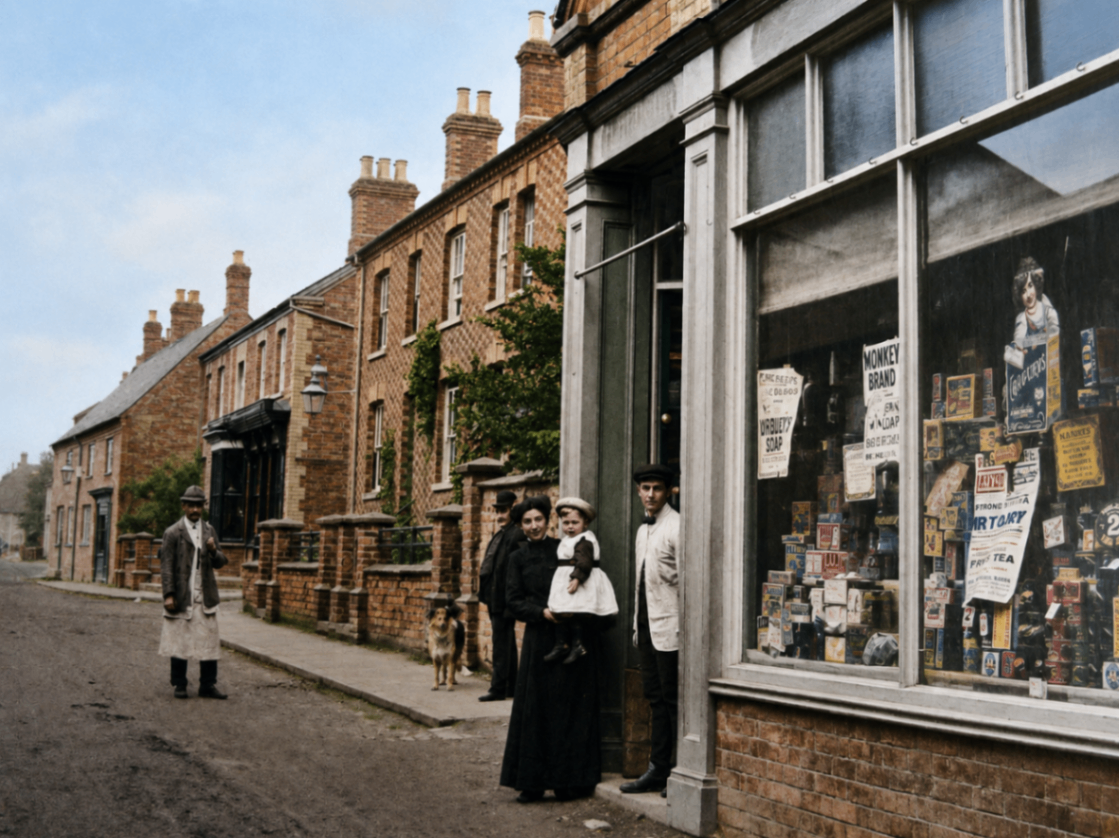 c.1905–1910
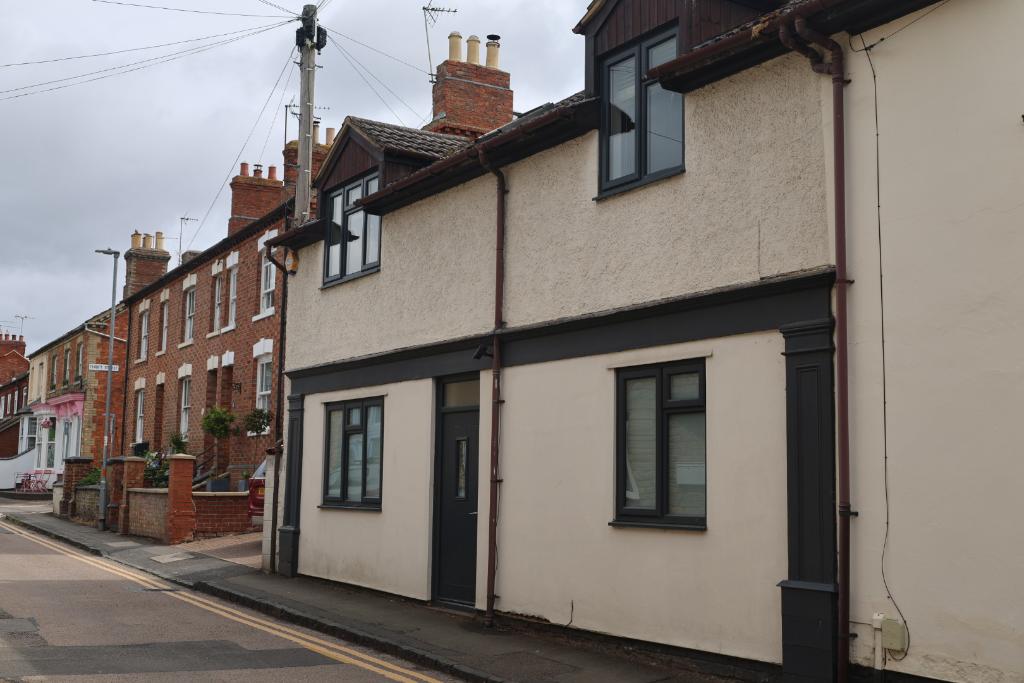 2026
2026Primary source — Kelly's Directory, 1901
The Village in 1901 — Services & Trades
Kelly's Directory of Northamptonshire for 1901 gives us a precise snapshot of Wollaston's commercial and civic life at the turn of the century — the Post Office, the police, the carriers who connected the village to the wider world, and the Coffee Tavern that served as a social hub.
Post Office
High Street Post Office
The sub-postmaster in 1901 was Frank Reynolds. The office was on the High Street and handled both letters and money orders.
- Letters arrive
- 7.00 am & 2.45 pm (from Wellingborough)
- Letters dispatched
- 5.20 pm & 8.00 pm
- Wall box cleared
- 9.15 am & 6.30 pm
- Sub-postmaster
- Frank Reynolds
Police
Wollaston Police Station
The village had its own police station in 1901. The constable in charge was Thomas Harding.
The location of the police station has not yet been confirmed. If you know where it stood, please get in touch.
Social life
Wollaston Club & Coffee Tavern
Opened in November 1893, the Wollaston Club and Coffee Tavern provided a temperance alternative to the public house. It had reading and news rooms, a billiard room, and around 160 members. The Coffee Tavern movement was a Victorian initiative to provide respectable social spaces for working men without the draw of alcohol.
The location of the Coffee Tavern building is not yet confirmed. Do you know where it was?
Carriers
Carriers to Northampton & Wellingborough
Before motor transport, carriers provided the vital link between Wollaston and the market towns. Kelly's 1901 records the following:
- Northampton: William Darnell (Tues & Fri), Arthur Summerlin (Tues & Fri)
- Wellingborough: Arthur Peck (daily), William Darnell (daily)
Carriers transported goods and passengers by horse-drawn wagon. The Darnell family appear on both routes, suggesting a substantial carrying business.
More village history
Explore the Co-op's full story, the Then & Now photograph gallery, garages, and financial services.
Wollaston Co-operative Society
Founded 6 November 1876 — the full story of how Wollaston's working families built one of the district's largest businesses from a halfpenny and a borrowed copy of rules.
Co-op historyThen & Now
Historic and modern paired photographs of the same Wollaston streets and buildings — a century apart. Can you help fill the gaps?
Then & Now galleryGarages & Petrol Sites
Pearson's Garage, Wollaston Motors (Ted Trembecki) and Shelton's — the three petrol sites that kept Wollaston moving through the twentieth century.
Garages pageBanks & Building Societies
Nationwide on Thrift Street, the Post Office Savings Bank (open from 1863), and the Barclays and Midland agencies recorded in Kelly's 1924.
Banks pageCan you help fill in the gaps?
This page depends on local memories. If you remember an old Wollaston shop, or have an old photograph, receipt, advert, paper bag, sign, postcard or family story, we would love to hear from you.
Open questions — can you help?
- Surname of "Jack" at Brown's shop, 67 London Road, in the 1950s — Davis or Davies?
- Further detail on Court Goodwill, the Wollaston branch of the Ancient Order of Foresters — meeting place, founding date?
- Addresses for the 1924 shopkeepers not yet confirmed: Luck, Palmer, Perkins, Watts, Woods.
- Exact location of William Packwood's draper's shop on London Road (destroyed by fire, 1905).
- Location of the Wollaston Police Station (recorded in Kelly's 1901, constable Thomas Harding).
- Location of the Wollaston Club and Coffee Tavern (opened November 1893).
Research notes
Some information on this page comes from residents' memories and Facebook discussions. These memories are valuable but may differ in dates, names or exact locations. Where possible, details will be checked against old photographs, trade directories, maps, Wollaston Heritage Society material and local archives.
Last updated: July 2026
Sources: Kelly's Directory 1901 & 1924; 1939 Register; Ivy Walker memoir / Wollaston Heritage Society; Facebook group memories; newspaper accounts.