
Village History
Wollaston Co-operative Society
Founded 1876 — the story of how Wollaston's working families built one of the district's largest businesses from a halfpenny and a borrowed copy of rules.
"When present-day Co-operators of Wollaston look back upon the dull days of the inception of their Society they have a just cause for gratification on their achievements."
In the 1870s, Wollaston was a village built on the boot and shoe trade — long hours, low wages and a system of shopkeepers' credit that kept working families in a cycle of debt. There were no Board Schools until 1873, and the idea that ordinary working people could own and run their own shop together was still a radical one, pioneered only a generation earlier by the Rochdale Pioneers.
Against this backdrop, a small group of Wollaston men gathered in the autumn of 1876 to discuss whether they might do the same. What followed was fifty years of steady, determined growth — from a few grocery lines in a borrowed front room to the largest distributive business in the immediate district.
6 November 1876
The Founding
The first meeting was held at the house of Mr Charles Loak on Long Street. Nine men gathered that evening: William Pratt, Charles Nutt, John Loak, Thomas Bailey, Thomas Maycock, Abel Green, Charles Loak Sr, Charles Loak Jr and John Kemshead. Three more joined at the second meeting to complete the founding twelve.
They needed a copy of the Rochdale rules to get started — and they needed to pay for it. The story goes that each man contributed a halfpenny to send for the rules. It was a small sum, but it was the beginning.
Officers were appointed: Charles Nutt as first Secretary, Mark Summerlin as first President, and William Pratt as first Treasurer. The Society was formally registered on 14 August 1877.
The Twelve Founders
The first store opened in Thomas Bailey's house on Long Street — only a few grocery lines to begin with. The Society soon moved to Thomas Haycock's premises at the bottom of St Michael's Lane, giving it a more prominent position in the village.
The first quarter's dividend was 2s. 6d. in the £ — a remarkable return that caused an immediate influx of new members. But the early days were precarious. Wholesale dealers refused to supply the new Society on credit. It was William Pratt who repeatedly stepped in, lending his own personal savings to replenish the stock and keep the shelves full.
In those first weeks, the founders were not above a little theatre to encourage confidence. Bold spirits would walk in and out of the shop to make it look busy — giving the impression of a thriving business to any passing sceptic.
Photographs
The Buildings
Four photographs of the Co-op's Wollaston premises survive. Together they document the Society's presence across the High Street and Thrift Street at its peak. The Central Stores at 5 High Street is now Ele's Bakes; the Newton Road grocery store is now the library; the Newton Road butcher's is now remembered as the Chinese takeaway.
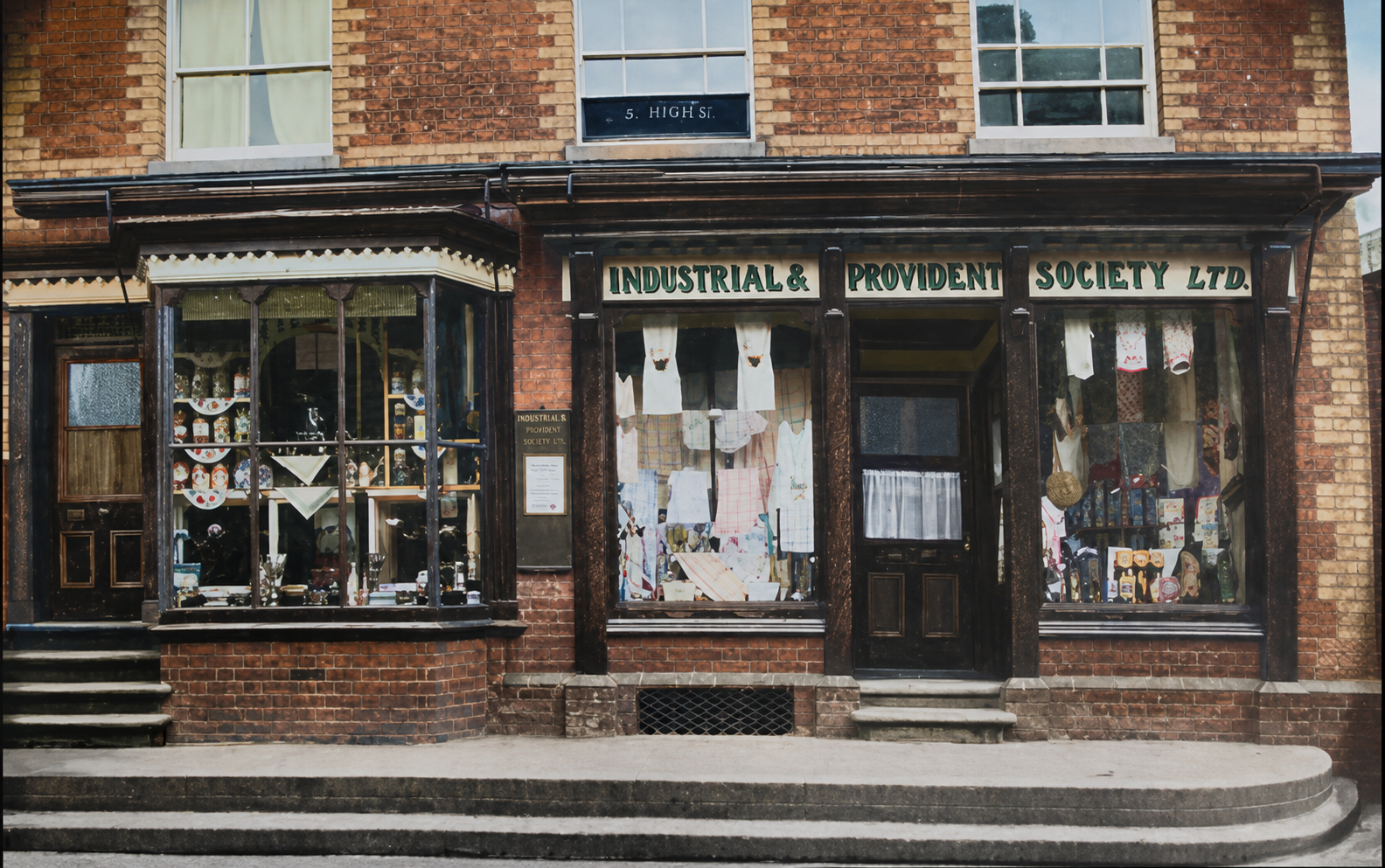
Co-op Central Stores, 5 High Street (corner of Thrift Street)
Now Ele's Bakes. The full "Industrial & Provident Society Ltd." fascia with bay window and drapery display.
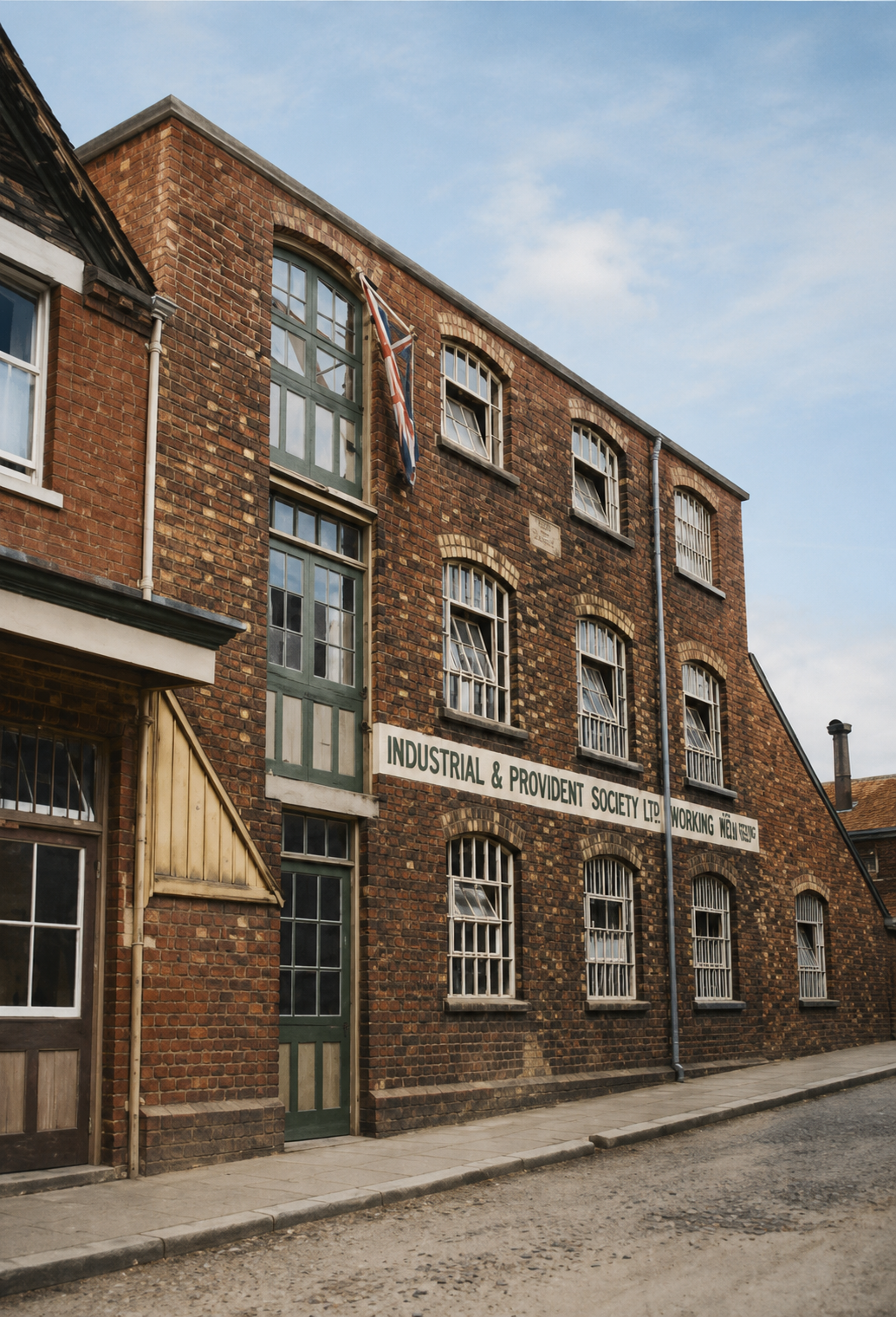
Bakery & Working Men's premises, Thrift Street
Three-storey brick building with arched windows. The full society name across the fascia; Union Jack flying.
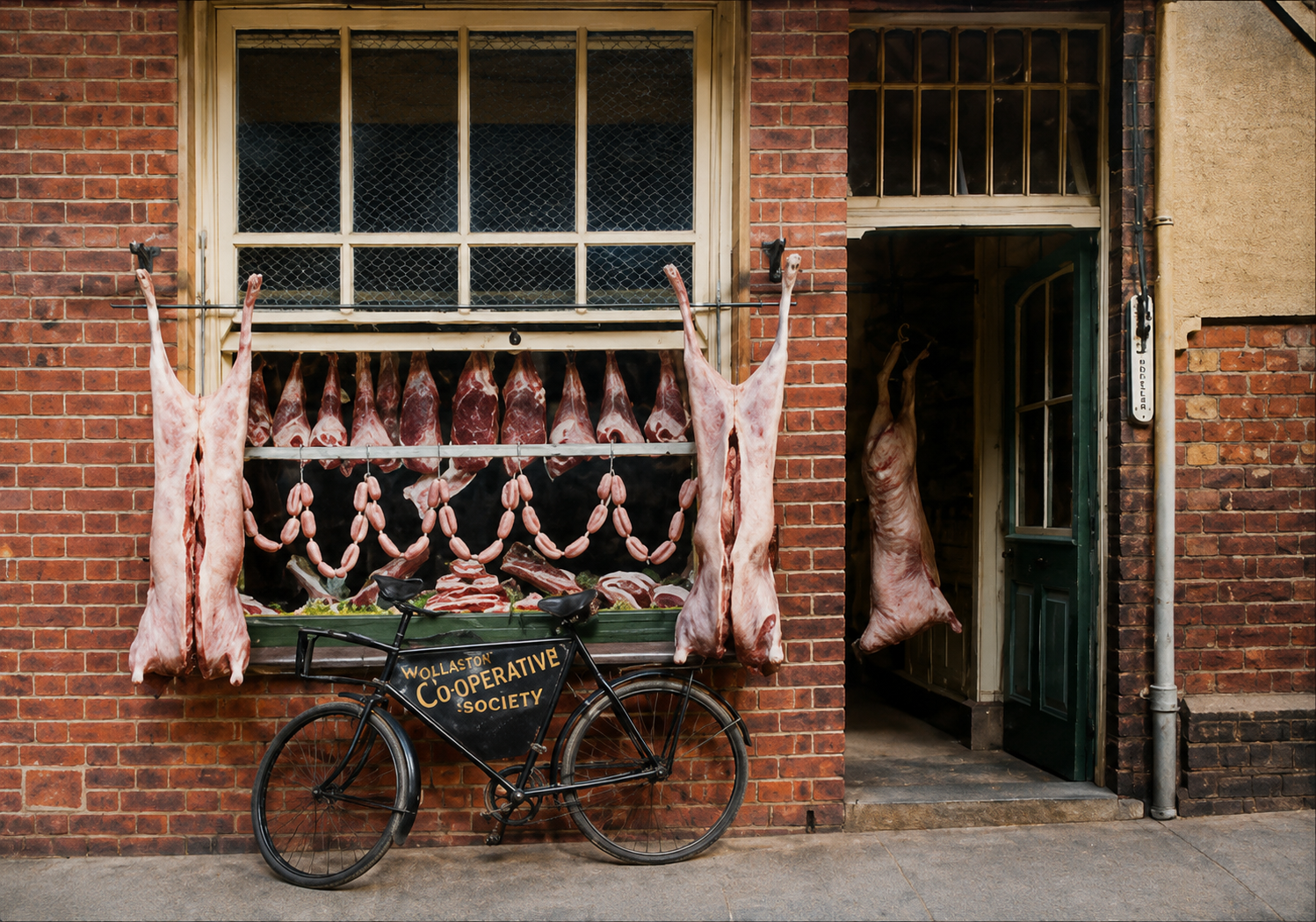
Co-op Butcher's, Thrift Street
The Wollaston Co-operative Society delivery bicycle in the foreground. Abattoir to the rear.
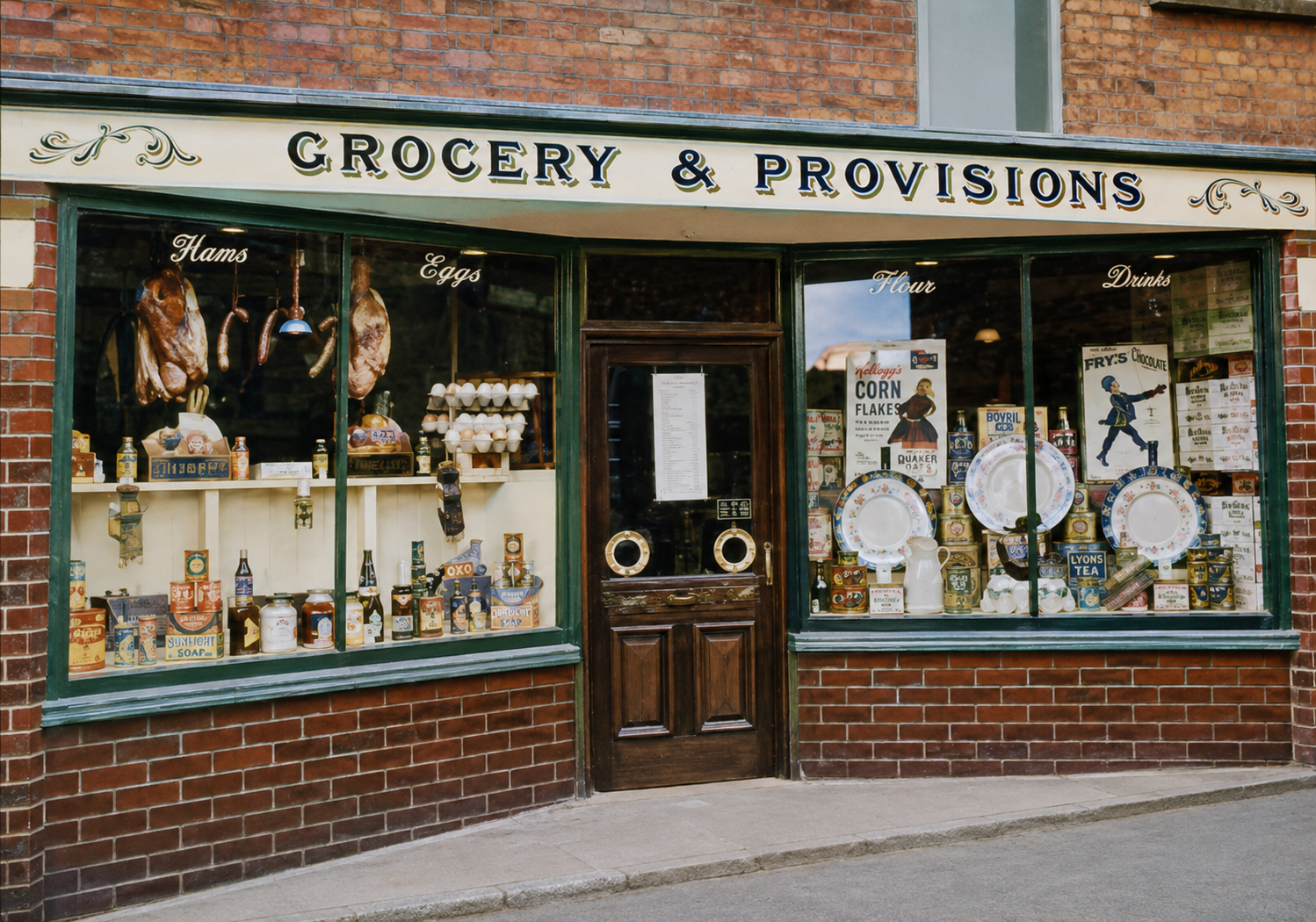
Co-op Grocery & Provisions
Kellogg's, Fry's Chocolate, Lyons Tea, Bovril and Sunlight Soap in the windows. Confirmed Wollaston; exact street unconfirmed.
Known premises
- 5 High Street (corner of Thrift Street)Central Stores — drapery, hardware, sweetsNow Ele's Bakes
- Thrift StreetBakery, Working Men's premises, coal yardBuilding survives; use changed
- Thrift StreetButcher's shop with abattoir to rearExact building unconfirmed
- High Street (exact building unconfirmed)Grocery & ProvisionsBuilding not yet identified
- Newton RoadLater Co-op grocery storeNow the library
- Newton RoadLater Co-op butcher'sNow remembered as the Chinese takeaway
- Hinwick Road10 cottages purchased 1894Investment property
- "The Moors" fieldPurchased 1896Land holding
From the minute books
Growth through the decades, 1880–1896
The Society's minute books record a steady expansion of services, property and membership across the late Victorian period. By 1926, Wakelin could describe it as "the largest distributive business in the immediate district."
- Committee: G. Woodhams, T. Rice, J. Summerlin, J. Pratt, J. Kemshead, S. Partridge.
- Penny Bank established.
- Butcher's shop erected — G. Brown's tender accepted.
- Coal Club established.
- Sick Benefit Society formed.
- No-credit rule introduced.
- Bakehouse re-erected.
- Secretary's salary raised to £2 per quarter.
- Society became annual subscriber to Northampton General Hospital.
- Only pork sold in the butchering department.
- New butcher's shop built.
- Bread checks issued.
- £100 invested with the Northamptonshire Productive Society Ltd.
- Coal merchant trade commenced.
- Horse and cart purchased.
- Plot of land purchased for stables.
- Bacon curing business commenced.
- Clothing, Furniture and Coal Club established.
- Stores closed at 12 noon on Bank Holidays.
- £1 subscribed towards improvement of St Michael's Lane.
- William Page appointed Manager and Secretary.
- William Pratt resigned as Treasurer after 16 years of service.
- Road from St Michael's Lane and Thrift Street into Hinwick Road — Society contributed £3.
- Joint cattle purchase with Bozeat Society.
- 10 cottages in Hinwick Road purchased.
- Meeting room let to Ambulance Corps free of charge.
- Shops closed at 2pm Thursdays for employees' half holiday.
- "The Moors" field purchased.
- Land in South Street acquired.
People
Key People
William Pratt
One of the original nine founders. Repeatedly lent his own personal savings to replenish stock when wholesale dealers refused to supply on credit. Served as Treasurer for 16 years before resigning in 1892.
Charles Nutt
Appointed first Secretary at the founding meeting. One of the original nine founders who gathered at Charles Loak's house on Long Street in November 1876.
Mark Summerlin
Appointed first President of the Society at its founding. The Summerlin family continued to be involved in village co-operative life — J. Summerlin appears on the 1880 committee.
I. Wakelin
Author of the Jubilee History 1876–1926, written to mark the Society's fiftieth anniversary. Published by the Manchester Co-op Printworks in 1926. His account is the primary source for the Society's early history.
J. F. Catlin
President of the Society at the time of the 1926 Jubilee. Named in the Jubilee History alongside I. Wakelin as the Society's leadership at its fiftieth anniversary.
J. W. Page / Woodhams family
William Page was appointed Manager and Secretary in 1892. George Woodhams served on the 1880 committee and the Woodhams family later managed the hardware store at the Central Stores. J. Darnell also served on the 1926 committee — the Darnell family appear across Wollaston's trading history.
Two co-operative traditions — an important distinction
The Wollaston Industrial and Provident Society Ltd (founded 6 November 1876) was a consumer co-operative — a shop owned collectively by its members, returning a dividend on purchases. This is the Society described on this page.
The Northamptonshire Productive Society (NPS), founded in 1881 by Wollaston shoemakers in a dove house on Thrift Street, was a workers' co-operative — a factory owned and run by the workers themselves. The NPS is the UK's oldest surviving workers' co-operative and is a separate organisation entirely.
The two traditions existed side by side in Wollaston, reflecting the village's deep roots in mutual aid and co-operative thinking. The 1876 Society even invested £100 with the NPS in 1887 — a sign of solidarity between the two movements.
Source & credit
This history draws on the Wollaston Industrial and Provident Society Ltd Jubilee History 1876–1926, written by I. Wakelin and published by the Manchester Co-op Printworks, 1926. Transcribed and made available online by the Rushden Research Group at rushdenheartsandsoles.co.uk.
Explore more
Related pages
Old Shops & Businesses
The full directory of Wollaston's former shops, traders and businesses — street by street, from the High Street to Newton Road.
Old Shops & BusinessesThen & Now Gallery
Historic and modern photographs of the same Wollaston locations — including the Co-op Central Stores at 5 High Street, now Ele's Bakes.
Then & Now gallery