
Wollaston Village
Village History
Wollaston is a village of around 3,600 people in Northamptonshire, with a history stretching back to the Saxon era. Its name derives from Wulflaf's Town — a reminder that this settlement is over a thousand years old.
The village has a primary and comprehensive school, local shops and Post Office, a part-time library, a Baptist Church, Methodist Church, Salvation Army citadel and the Anglican church of St Mary the Virgin. It is an industrial village, with Scott Bader — a chemical company — among its main employers. The village's shoemaking heritage lives on through R. Griggs & Co, who still produce selected "Made in England" Dr. Martens at the Cobbs Lane factory, and NPS Shoes — makers of Solovair — whose factory on Thrift Street has been a workers' co-operative since 1881.
The ancient centre of the village, including Wollaston Hall, the 14th-century towered church and partly mediaeval priory, is well-preserved and forms the core of the Conservation Area. Wollaston Museum at 102 High Street houses many village artefacts and is open to the public.
Origins
The Origins of Wollaston
Wollaston is a rural village in Northamptonshire, situated on the A509 between Wellingborough and Bozeat, on a hill four miles south of Wellingborough, bounded by the River Nene.
The name of Wollaston comes from Wulflaf's Town — Wulflaf being an early Saxon settler. When Wollaston first developed it grew along a line, starting at Cobbs Lane and continuing past the clusters of Bell End at one end and Rotten Row / St Michael's Lane at the other end of the High Street, and on towards Strixton.
The ancient centre of the village, including Wollaston Hall, the 14th-century towered church and partly mediaeval priory, is well-preserved and now forms the core of the Conservation Area.
Wollaston's scheduled monuments include the site of a mediaeval manor house at the south end of the village.
Beacon Hill
Beacon Hill — The Oldest Part of the Village
The oldest part of the village is Beacon Hill, an ancient castle earthwork which belonged to Bury Manor, and which used to be called Mill Hill. It is a circular mound about 10 metres high, surrounded by a great ditch.
When investigated, the earthwork was found to date back to the 12th century. The mound is open to the public and nearby Wollaston Museum houses many village artefacts.
Near the church lies the circular mound — about 10 metres high, surrounded by a ditch — dating from the 12th century.
The Fair
The Wollaston Fair — Granted 1260
In 1260, Wollaston was granted a charter by Henry III to hold an annual fair. This was probably held at Michaelmas (September or October) and was held in St Michael's Lane — which is no doubt how that street derived its name.
The Michaelmas fair charter of 1260 is one of the earliest recorded events in Wollaston's documented history.
The First School
The First School in Wollaston
The first school was opened in Wollaston in 1842. It was held in the building adjacent to the Cuckoo, opposite Bell End, and was a private school run by a curate, the Reverend J. J. Scott, out of his own funds.
The school was not government controlled until 1873. The building was then bought by the Keep family, and the school was subsequently held in the parochial rooms in College Street — then known as the Backway.
Rev J. J. Scott funded the school entirely from his own pocket for over thirty years before it came under government control.
The Houses
The Houses and Their Bricks
The lovely mottled red and orange bricks seen around Wollaston came from two brickyards within the village itself — one along Grendon Road near Cringle Farm, and the other where the industrial estate now stands.
If you look closely, you can see that the patterns of the courses differ from the way houses are built today: some have a checkerboard effect, some look striped. Another interesting feature is the way bricks are laid according to the lie of the land — if the land sloped, the wall sloped too.
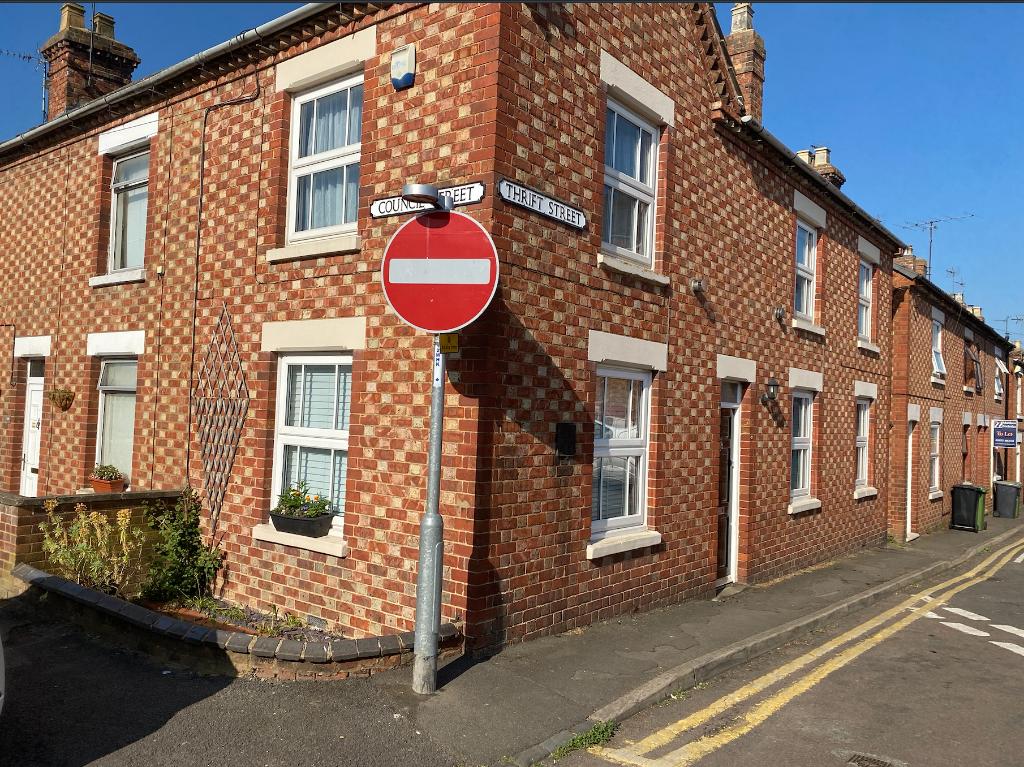
The distinctive mottled brickwork is a visible reminder that Wollaston once had its own brickyards supplying the whole village.
The High Street
The High Street
The High Street was at one time cobbled, and this is sometimes still visible when the road surface begins to wear at the edges. The smithy — or the forge — was located opposite the Methodist church, and part of it can still be seen today.
Traces of the original cobbled surface occasionally reappear at the edges of the High Street after heavy wear.
Population & Landowners
Population, Landowners & Village Services — c.1901
By the time of the 1901 census, Wollaston had a population of 2,308 — up from 1,904 in 1891, reflecting the growth of the boot and shoe trade. The principal landowners were the Earl Spencer KG and Colonel Joseph Hill JP, who was lord of the manor.
The village was served by a Post Office on the High Street, with Frank Reynolds as sub-postmaster. Letters arrived from Wellingborough at 7.00 am and 2.45 pm, and were dispatched at 5.20 pm and 8.00 pm. A wall letter box was cleared at 9.15 am and 6.30 pm.
The village also had a police station, with Thomas Harding as the constable in charge.
Gas was supplied by the Wollaston Gas & Coke Company, whose works were erected in 1872 at the south end of the village.
The Bettles charity, established by legacy, provided £21 11s yearly — £4 for choir books and the remainder distributed as food for the poor of the parish.
Industry
The Boot & Shoe Trade
Wollaston is an industrial village whose past — and present — is defined by the boot and shoe trade. R. Griggs & Co — makers of Dr. Martens boots — has been based here since 1901, and the Cobbs Lane factory still produces selected "Made in England" boots today. NPS Shoes, founded in Wollaston in 1881 as the Northamptonshire Productive Society — the UK's oldest surviving workers' co-operative — still manufactures the Solovair brand from Thrift Street using traditional Goodyear-welt techniques. From 1960 to the mid-1990s, NPS also made Dr. Martens boots under licence.
Like much of Northamptonshire, Wollaston had a thriving boot and shoe industry from the mid-Victorian era. Several small factories and outworkers' cottages produced footwear for national distribution. At its peak, the trade employed a significant proportion of the village's working population.
The industry's legacy is visible in the architecture of the village — the terraced workers' cottages, the former factory buildings, and the chapels built by prosperous manufacturers. Wollaston remains one of the few places in England where you can still watch boots being made by hand, on the same streets where the trade has been practised for over a century.

"Boot and shoe making is the principal industry here, and affords employment to a large number of the inhabitants; others are engaged in agriculture, and in making mats of the rushes which grow in the Nene and neighbouring streams."
Kelly's Directory, 1910
Boot & Shoe Manufacturers in 1910
Kelly's Directory of 1910 records the following boot and shoe manufacturers operating in Wollaston at the peak of the trade. These names represent the families and firms that shaped the village's economy and built many of its streets.
The Shelton family name appears four times — reflecting their dominance in the local trade. The Northamptonshire Productive Society (NPS) is the workers' co-operative that still manufactures Solovair boots on Thrift Street today.
Village in numbers — 1910
"The village is lighted with gas from works situated at the south end of the village, erected in 1872 by the Wollaston Gas and Coke Company Limited."— Kelly's Directory, 1910
Agriculture & other trades
Alongside the shoe trade, Kelly's records a significant farming community in 1910 — Harris Arthur Edward, Sanders Cecil & John Nethercote, Smart Amos, Tarry Elizh., Wainwright Edward among others. Rush mat-making from Nene rushes is also noted — a cottage industry now almost entirely forgotten.
Other trades listed include wheelwrights (Lovell W. & Son), farrier (Boyson Edwin Thomas), general smiths (Summerlin John & Charles), and a cycle repairer (Sherwood Geo. Edmd.) — a snapshot of a village economy far more varied than the shoe trade alone.

Churches & Faith
St Mary the Virgin & the Village's Churches
The parish church of St Mary the Virgin has stood at the heart of Wollaston since the 14th century. Its towered silhouette is one of the defining images of the village and a landmark visible for miles across the Nene valley.
Wollaston also has a Baptist Church, a Methodist Church and a Salvation Army citadel — a reflection of the strong Nonconformist tradition in Northamptonshire's working communities, particularly among those employed in the boot and shoe trade.
Help us tell Wollaston's story
If you have photographs, documents, family memories or local knowledge that could enrich this history, we'd love to hear from you. Every contribution helps build a fuller picture of village life across the centuries.
Visit in person
Wollaston Museum, Curiosity Cottage & Beacon Hill
102 High Street · Open Apr–Sep, Wed & Sun 2:30–4:30pm