
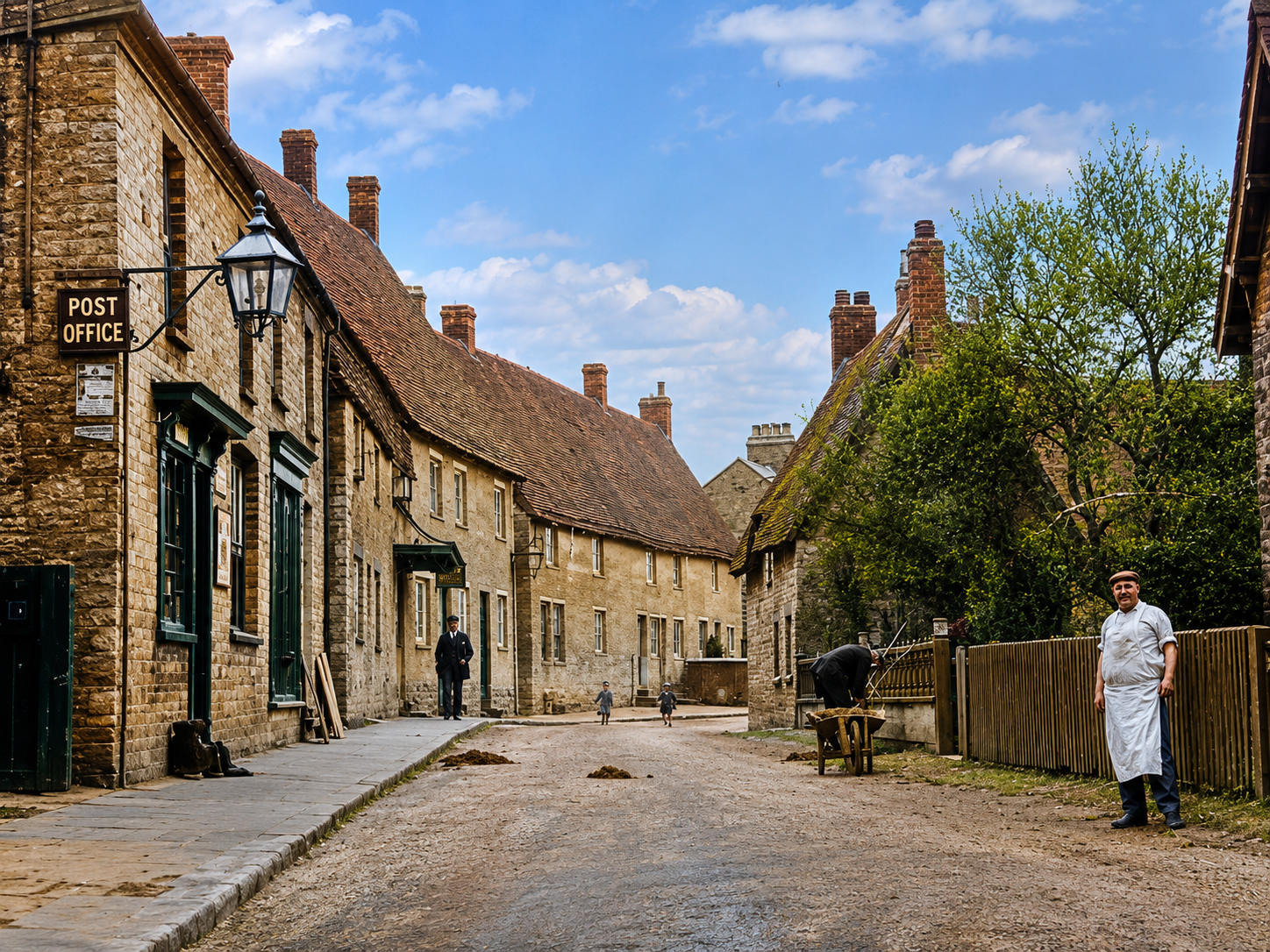
The Story of Wollaston's Post Office
For generations, Wollaston's Post Office was far more than somewhere to buy stamps. It connected the village with the rest of Britain through letters, telegrams, savings accounts and government services, while several generations of one local family served behind its counter.
Before the telephone, before the internet — even before most people had bank accounts — the Post Office was the beating heart of village communications. In Wollaston, it was the place where almost every resident came regularly, whether to send a letter, deposit savings, receive a pension or dispatch an urgent telegram.
The Post Office served simultaneously as the village's communications hub, its bank, its telegraph office and its government service centre. Understanding its history is to understand how Wollaston was connected to the wider world across more than a century of change.
Origins & Early History
Wollaston's postal history stretches back at least to 1845, when the village already had an established Post Office administered through Wellingborough Head Office. In those early decades it was a simple mail collection point — but over the following thirty years a series of nationally-introduced services transformed it into the village's communications and financial hub. The Money Order Office arrived in 1862, the Savings Bank in 1863, and a Telegraph Office was operating by 1877. Each addition is recorded in the Timeline below.
Wollaston's First Postmark
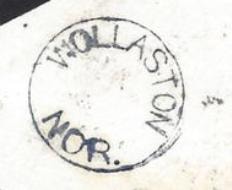
Introduced in 1851 — the earliest known standard postmark for Wollaston.
The Undated Circular (UDC) Handstamp
In 1851, Wollaston was issued with its first Undated Circular postmark — known to postal historians as a UDC. The handstamp simply reads WOLLASTON NOR., where "NOR." is the standard abbreviation for Northamptonshire.
Unlike the datestamps that would follow, the UDC contained no date. Its purpose was purely to identify the office where mail entered the postal network — a mark of origin rather than a record of time. Every letter posted in Wollaston would have left the village bearing this impression.
Its survival on envelopes and covers is a direct physical link to the village's Victorian postal history.
Victorian village Post Offices rarely stood alone. They were typically combined with grocery shops, general stores or other businesses — the Postmaster supplementing a modest postal salary with trade. Wollaston was no different.
1871 Census
Watson George Parbury
"Grocer & Postmaster"
This reflects the common Victorian practice of combining a village grocery business with the Post Office. Parbury's dual role was typical of the era — the Post Office brought regular custom, while the grocery provided the main income.
By 1874, a trade directory confirms the full range of services already on offer: "Post, Money Order Office and Savings Bank — Watson George Parbury, Postmaster." This establishes clearly that Wollaston already offered postal, money order and savings bank services before the Reynolds family took over — the infrastructure was already in place.
Research note: The full story of Parbury's tenure, the exact premises he used, and the transition to the Reynolds family awaits further investigation. If you have information, please get in touch.
The Reynolds Family
Around sixty years of service to Wollaston
No family is more closely associated with Wollaston's Post Office than the Reynolds family. From at least 1881 until 1940, they served the village across two generations — a remarkable span of nearly sixty years.
Joseph Fairey Reynolds (1838–1897)
By 1881, Joseph Reynolds was established as Postmaster, with the census recording him at the Long Street Post Office — Long Street being the earlier name for what is today the High Street. He ran the Post Office as a family enterprise, drawing his children into the work.
1891 Census — The Reynolds Household
It is striking that two daughters worked as Telegraph Clerks — a skilled, examined occupation — while Frank initially worked in Wollaston's boot and shoe industry before eventually following his father into the Post Office.
Frank Reynolds (1868–1947)
When Joseph died in 1897, Frank stepped into the role of Sub-Postmaster. He would hold the position for an extraordinary 43 years, becoming one of the most familiar and trusted figures in the village.
"Former Sub-Postmaster… held the position for 43 years from 1897 to 1940."
What Could You Do at the Post Office?
Six services under one roof — and one counter
Post Office
Stamps, letters and parcels sent across Britain and the Empire. Every household depended on it.
Money Order Office
A safe way to send money anywhere in Britain — essential before bank accounts were common.
Telegraph Office
Urgent messages transmitted in minutes using Morse Code — the Victorian equivalent of a text message.
Telegraph Money Orders
Money transferred instantly by telegraph — a remarkable innovation for its time.
Post Office Savings Bank
A trusted, government-backed savings account available to ordinary working people.
Government Insurance
Life insurance and annuities sold through the Post Office — affordable protection for families.
Telegraphs — The Victorian Internet
Before the telephone reached ordinary homes, the electric telegraph was the fastest way to send a message across Britain. A telegram could travel hundreds of miles in minutes — a miracle to Victorian eyes. The message was encoded in Morse Code, transmitted along telegraph wires, and delivered by hand to the recipient.
Telegraph Clerks were highly skilled professionals. They had to pass examinations in Morse Code — the system of dots and dashes that represented letters and numbers — and work quickly and accurately under pressure. Urgent messages about births, deaths, business matters and emergencies all passed through their hands.
Kate & Rose Reynolds — Telegraph Clerks
In an era when women's professional roles were severely limited, Kate and Rose Reynolds held skilled, examined positions at the heart of the village's communications network. They were not simply helping out in a family business — they were qualified professionals, certified in Morse Code, trusted with messages that could not wait. Their work connected Wollaston with the wider world, one transmission at a time.
The Post Office Savings Bank
In a village like Wollaston, where the nearest bank branch would have been in Wellingborough, the Post Office Savings Bank was often the only practical financial institution within reach. It was not just a place for letters and parcels — it was where working people kept their money safe.
The Post Office Savings Bank was established nationally on 16 September 1861 by Act of Parliament, with the explicit aim of bringing secure, interest-bearing savings accounts within reach of people who had never had access to a bank. The minimum deposit was one shilling — within reach of a servant, a child, a labourer or a tradesman. Deposits were backed by the government, which made the Post Office Savings Bank uniquely reliable at a time when private banks could and did fail.
Commemorated in Stamps
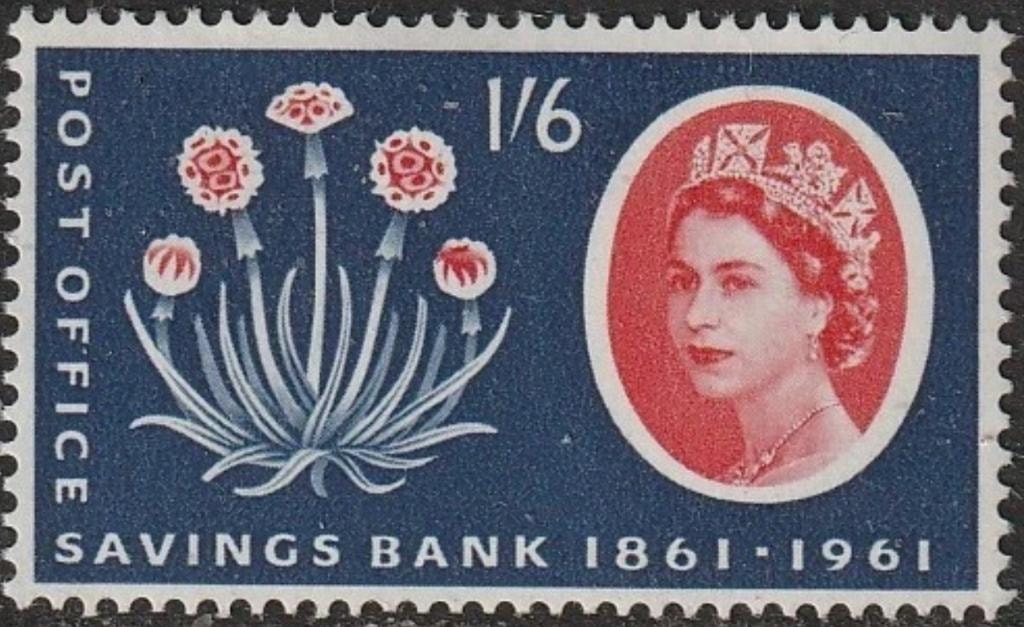
1961 National Savings Bank Centenary stamp, 1s 6d — the Thrift Plant.
100 Years of Savings — 1861 to 1961
In 1961, the centenary of the Post Office Savings Bank was marked with a commemorative stamp issue. The 1s 6d value — shown here — features a Thrift Plant (Armeria maritima), chosen as a symbol of careful saving. The name "thrift" itself carries a double meaning: the plant, and the virtue.
It is a fitting image for a service that, for a century, had encouraged the people of villages like Wollaston to set aside a little each week — and to trust the Post Office to keep it safe.
What the Savings Bank Meant for Wollaston
For the families of Wollaston — boot and shoe workers, farmers, domestic servants, tradesmen and their children — the savings bank offered something that had simply not existed before: a safe place to put money aside, earn a little interest, and draw it out when needed, without travelling to Wellingborough or dealing with a private bank.
Children were actively encouraged to save. Schools promoted the habit. A penny a week, deposited regularly, could grow into a meaningful sum. For a working family, the Post Office savings book was often the only financial cushion they had.
Who Used the Post Office Savings Bank?
The Sub-Postmaster as Financial Clerk
Behind the counter, the Sub-Postmaster — or Sub-Postmistress — was far more than a seller of stamps. By the late Victorian period, a typical day might involve handling incoming and outgoing mail, issuing postal orders and money orders, processing savings deposits and withdrawals, selling National Savings certificates, and paying out old-age pensions after 1909.
For Frank Reynolds, who held the position from 1897 to 1940, this was simply the job. He would have known the savings books, the pension entitlements and the financial circumstances of a large part of the village — a quiet but considerable responsibility, carried for over four decades.
Research note: The confirmed date for Wollaston's Savings Bank opening is 2 March 1863, recorded in Post Office records. Whether the service was offered from the first day of the national scheme in September 1861 is not yet established — further research may clarify this.
Mail Arrivals & Collections
By 1910, Kelly's Directory recorded the full postal arrangements for Wollaston. Letters arrived from Wellingborough, with both morning and evening collections. A wall letter box provided a convenient drop point for residents. The rhythm of the postal day shaped village life — the arrival of the morning post was a daily event.
A typical working day around 1910 would have begun before dawn — sorting the incoming post from Wellingborough, opening the counter for early customers, handling telegrams as they arrived, and closing only after the last evening collection had been dispatched.
The Post Office & Village Life
The Post Office was one of the few places that every resident visited regularly, regardless of age, occupation or social standing. Farmers, servants, schoolchildren, widows, tradesmen — all came through the same door.
For many Wollaston families, the Post Office was their only connection to the financial system — their savings bank, their insurance provider, their means of sending money to relatives in other towns. Frank Reynolds, standing behind that counter for over forty years, would have known almost every family in the village by name.
Timeline
Post Office established in Wollaston, administered through Wellingborough Head Office.
Wollaston issued with its first Undated Circular (UDC) postmark — reading "WOLLASTON NOR." — the earliest known standard postmark for the village.
Money Order Office introduced, allowing residents to send money safely anywhere in Britain.
Post Office Savings Bank opens in Wollaston — a government-backed savings account for ordinary working people.
Telegraph Office operating in the village, enabling urgent messages to be sent across Britain in minutes.
Watson G. Parbury recorded as Grocer & Postmaster in the census.
Directory records Post, Money Order Office and Savings Bank under Parbury — confirming the full range of services before the Reynolds family era.
Joseph Fairey Reynolds recorded at Long Street Post Office (today's High Street).
Census records Joseph, Kate and Rose Reynolds — two daughters as Telegraph Clerks.
Joseph Reynolds dies; Frank Reynolds succeeds as Sub-Postmaster.
Kelly's Directory records full postal services and collection times.
Telephone Exchange opens at 42 High Street, Wollaston.
Martha Smart recorded as Post Office Clerk.
Frank Reynolds retires after 43 years of service.
Frank Reynolds dies, aged 79.
Post Office relocates to Whibley's, 37 High Street, operating as a Post Office Local branch.
More discoveries to be added as research continues…
Gallery
The Same View — Then & Now
Early twentieth century — the High Street looking south, Post Office on the left
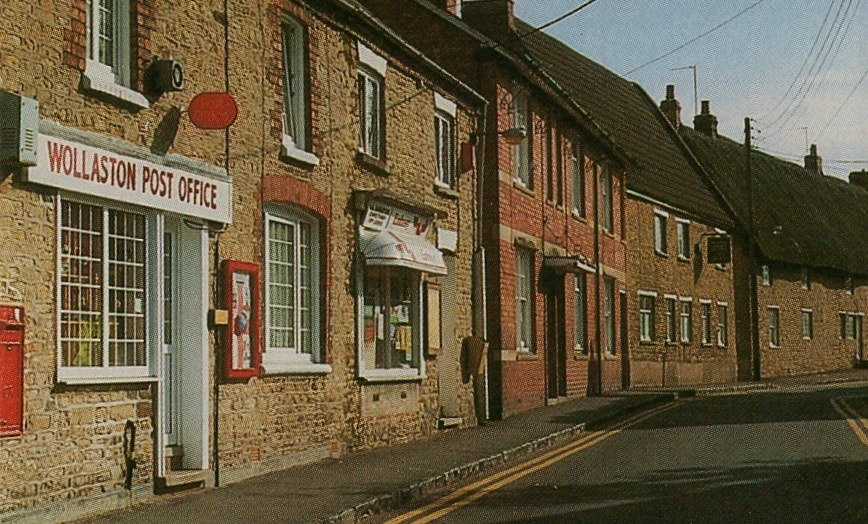
The same scene in the 1980s — the Post Office sign, red postbox and double yellow lines marking the change of era
Did You Know?
Wollaston has enjoyed continuous postal services for at least 180 years — from a simple Victorian Post Office serving the village through Wellingborough, it grew to offer Money Orders, Savings Bank accounts, telegraph services, government insurance and pensions, making it one of the community's most important public institutions.
Telegrams were charged by the word — senders kept messages as short as possible.
The Post Office sold life insurance, making financial protection available to ordinary working families.
The Post Office Savings Bank was founded in 1861 — decades before most people had bank accounts.
Villagers could send money to anywhere in Britain using a postal money order.
Telegraph Clerks had to pass examinations in Morse Code — a highly skilled and respected occupation.
By 1910, Wollaston had both a morning and evening postal collection, connecting it daily with Wellingborough.
Help Tell the Story
This page is a living document — we expect it to grow as more is discovered. If you have memories, photographs or documents connected with Wollaston's Post Office, we would love to hear from you.
We are particularly looking for: