
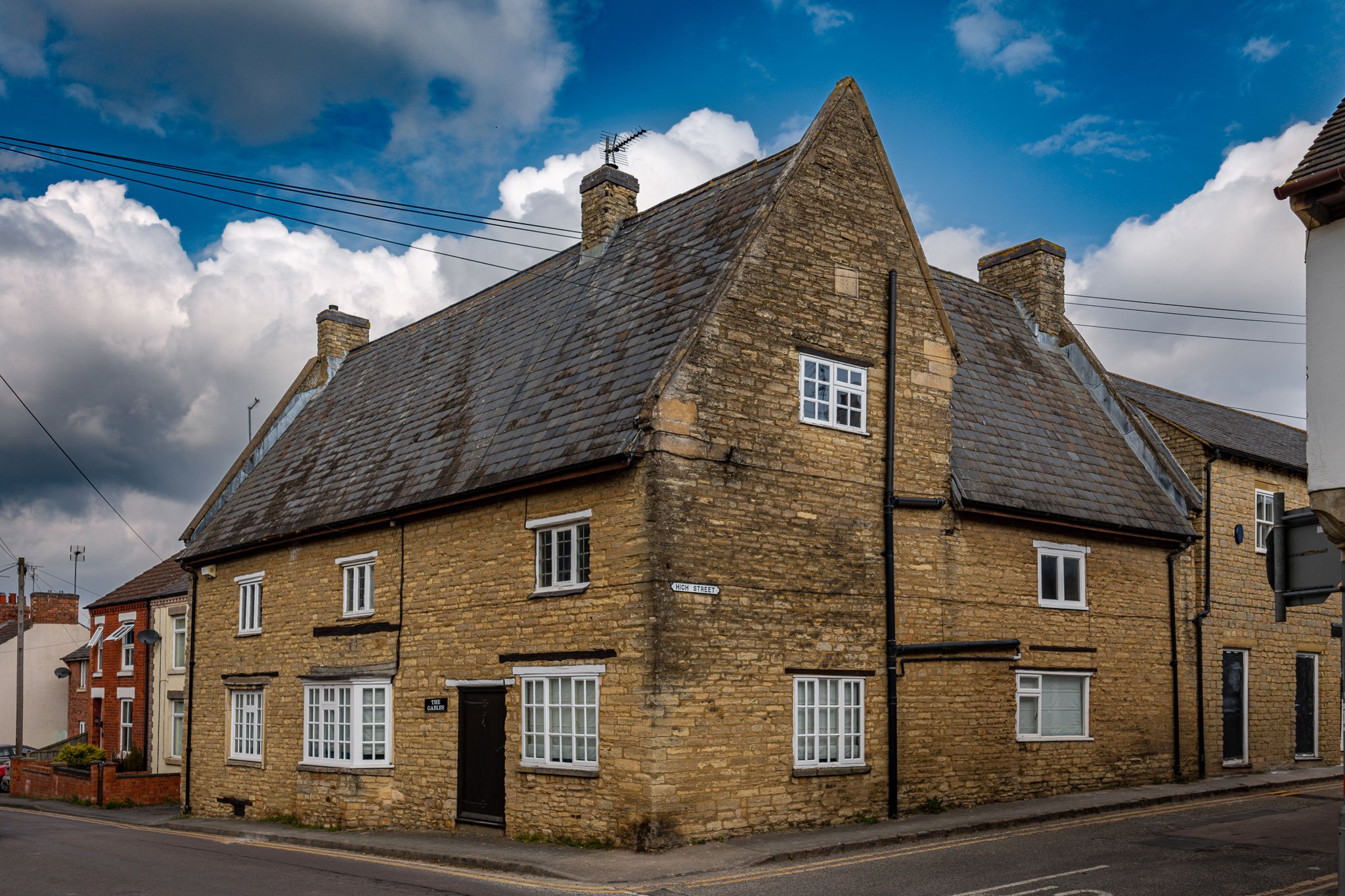
The Gables
55 London Road — a 17th-century limestone house dated 1678, Grade II listed, at the junction of London Road and High Street
55 London Road, Wollaston
A House Worth a Second Glance
The Gables stands at 55 London Road, Wollaston, at the junction with the High Street — a position that has made it one of the most visible yet most overlooked historic buildings in the village. Its datestone records the year 1678, making it one of the oldest surviving domestic buildings in Wollaston. Added to the National Heritage List for England on 2 August 1972, it carries a Grade II listing that recognises its special architectural and historic importance.
Historic England describes it as an L-shaped two-storey house with attic, built in the local limestone tradition. Its features include leaded casement windows, gable parapets and evidence of a former central carriage arch — details that speak to a substantial household of the late 17th century. Although many people drive past without giving it a second glance, it is one of the most significant surviving historic houses on the southern approach to the village.
Datestone
1678
Late 17th century
Listing
Grade II
Listed 2 August 1972
Construction
Local limestone
L-shaped, two storeys & attic
Photograph
The Gables today
The Gables at the junction of High Street and London Road — the distinctive double gables, ironstone walls and "High Street" sign on the corner wall. The building's prominent position at this junction has made it a landmark on the southern approach to the village for centuries. Photograph 2026.
Photograph
2026
Then & Now — coming soon
We are looking for older photographs of The Gables and this junction to create a Then & Now comparison. If you have historic photographs of 55 London Road or the High Street / London Road corner, please get in touch.
Share a photographContext
The Setting
London Road was historically the principal route south towards Northampton and London. As Wollaston expanded beyond its earliest settlement around Beacon Hill, Bell End and the church, more substantial houses began to appear along this route. The Gables, dated 1678, was built during the late Stuart period — a time when Wollaston was still primarily an agricultural and lace-making community, long before the boot and shoe trade transformed the village.
The Gables occupies a position that would have been considered prominent. Its L-shaped plan, gable parapets and evidence of a former carriage arch suggest a household of some means — a prosperous farmer, a local merchant, or a gentleman of the village. In 1678, Wollaston was a very different place: the great shoe factories were still two centuries away, and the village economy revolved around the land, lace-making and small-scale trade.
Like the church and a handful of other surviving structures, The Gables is a rare physical link to Wollaston before industrialisation — a building that has stood at this junction through the Civil War's aftermath, the agricultural revolution, the rise and fall of the boot and shoe trade, and into the present day.
The Building and its Features
Historic England's listing description records The Gables as an L-shaped two-storey house with attic, built in the local limestone tradition characteristic of this part of Northamptonshire. The gable parapets that give the building its name are a feature of late 17th-century domestic architecture in the region, and the leaded casement windows are consistent with a building of this date and status.
The evidence of a former central carriage arch is particularly significant — it suggests that the original building included a through-passage or coach entry, a feature associated with prosperous households that kept horses and vehicles. This detail points to an original owner of some standing in the community.
Key architectural features
- Datestone 1678 — late Stuart period, pre-dating the boot and shoe era by two centuries
- Local limestone construction — the same material used throughout historic Wollaston
- Gable parapets — the distinctive feature that gives the building its name
- Leaded casement windows — consistent with late 17th-century domestic architecture
- Former carriage arch — evidence of a substantial original household
Heritage Plaque and Further Recognition
Recent Parish Council minutes suggest there is continuing local interest in recognising The Gables' history through a heritage plaque. Given the building's age — predating the American Declaration of Independence by nearly a century — and its prominent position at the High Street junction, such recognition would be well deserved.
Further research may also clarify possible links with Wollaston's former laundry history. The building's size, its carriage arch and its position on a main road would have made it suitable for a variety of commercial uses over its 350-year life. Census returns, trade directories and estate records from the 17th century onwards are likely to reveal a rich succession of occupants.
Future Research Opportunities
This page is the beginning of the story, not the end. The following sources could considerably expand what we know about The Gables and its occupants:
You may find that one of Wollaston's notable shoe manufacturers, local councillors or business owners lived there at some point. If you have memories, photographs, documents or any information about The Gables or its former occupants, please share them with us.
Explore more of Wollaston's heritage